A cardboard poster tube weighs almost nothing, yet it can cost more to ship than a filled corrugated box twice its weight. The reason has little to do with the tube itself and everything to do with how parcel carriers treat cylinders. Long, round packages are harder to run through automated sortation, so carriers add fees that never show up in the base rate you quoted. If you buy or design shipping tubes, understanding those fees is the difference between a margin that holds and one that quietly leaks a few dollars per order.
The surcharge tubes trip most
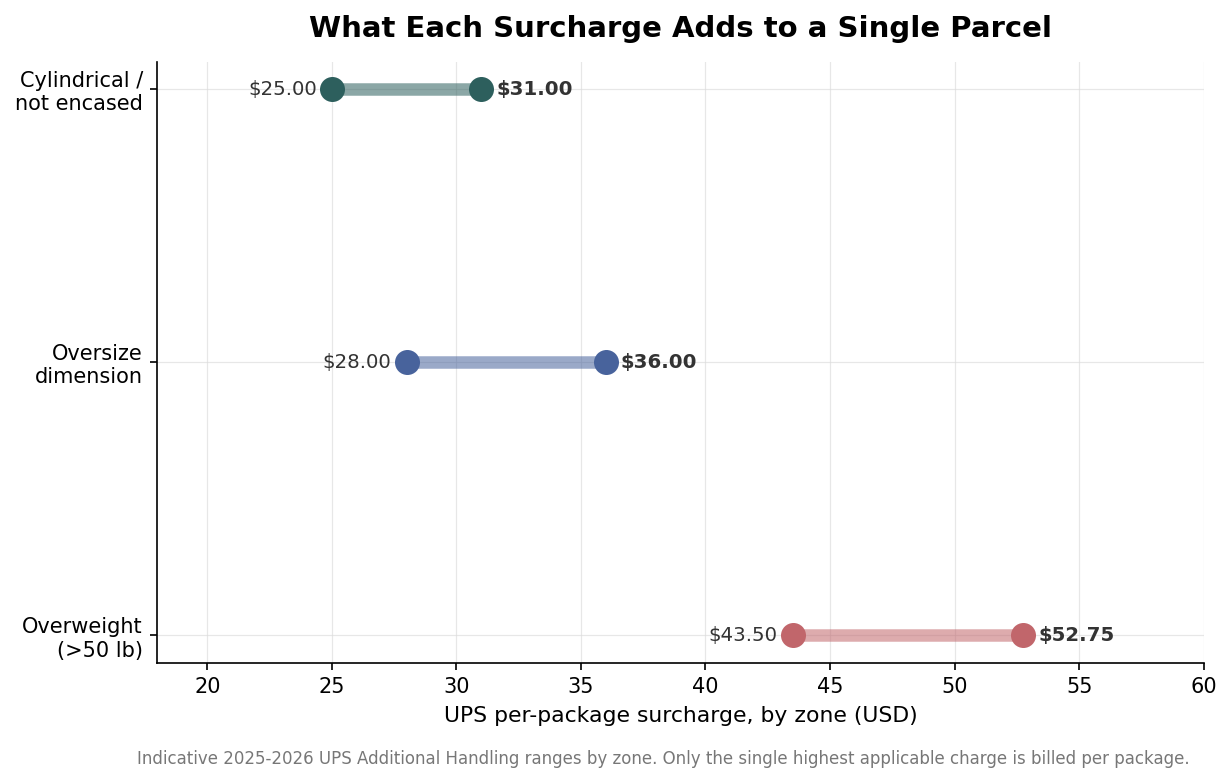
The one to know first is Additional Handling on packaging. UPS and FedEx both apply this to items that are not fully encased in a corrugated box, and they name cylindrical packaging, tubes, cans, pails, and drums, specifically. A kraft mailing tube is exactly that kind of package. It means a tube can be assessed the fee even when it is short, light, and well within every size limit, purely because of its shape. Recent UPS schedules put that packaging surcharge in the range of about 25 to 31 dollars per package depending on zone, and it is charged on top of the regular rate.
This is the fee most tube shippers overlook, because it is not tied to weight or a dimension you can easily read off a spec sheet. It is tied to the format. Whether a given carrier and account actively assesses it on your tubes is worth confirming directly, since enforcement depends on inspection and scanning, but you should price as though it may apply rather than assume it will not.
The dimension cliffs
On top of the packaging rule, tubes run into length-based surcharges because they are long by nature. UPS applies Additional Handling once a package’s longest side exceeds 48 inches, its second-longest side exceeds 30 inches, or length plus width passes 105 inches. Cross one of those lines and the dimension version of the fee, roughly 28 to 36 dollars per package by zone, replaces the packaging one. Only the single highest applicable charge is billed, so a long tube pays the bigger of the two, not both.
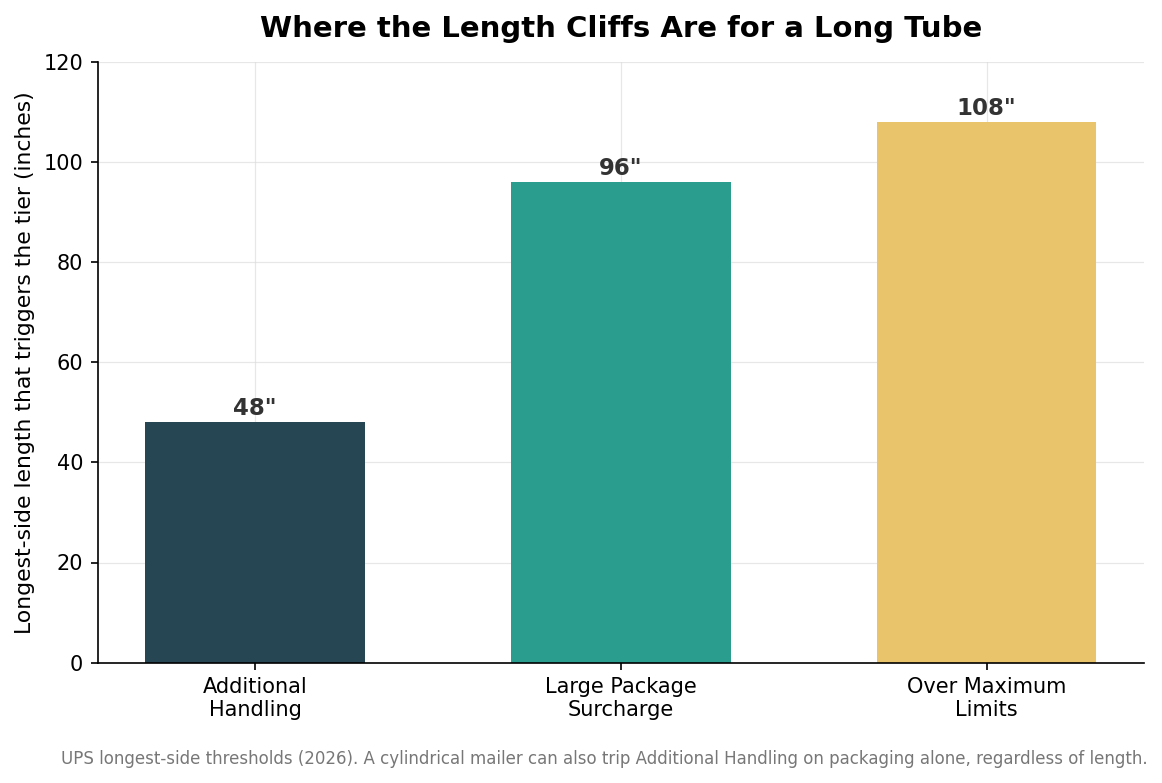
Above those thresholds sit two more tiers. The Large Package Surcharge triggers when the longest side passes 96 inches or length plus girth passes 130 inches, and it is a much steeper charge, commonly in the low hundreds of dollars per package. Beyond that, Over Maximum Limits begins at a 108-inch length or 165 inches of length plus girth and carries a flat penalty near 1,875 dollars, at which point the carrier may simply refuse the package. Girth here is measured as twice the width plus twice the height, so for a round tube it works out to about four times the diameter.
What each surcharge actually costs
Seeing the fees side by side clarifies where the money goes. The packaging and dimension charges cluster in the high twenties to mid thirties, while an overweight package, over 50 pounds, jumps to the mid forties or low fifties. Tubes almost never hit the overweight tier, which is the good news; their exposure is concentrated in the packaging and dimension charges, and those are the ones your spec can influence.
Run the girth math and most tubes stay comfortably clear of the Large Package tier. A 37-inch tube with a 4-inch diameter has a length plus girth of about 53 inches, and even a fat 49-inch tube at 6 inches across lands near 73 inches, both far below the 130-inch line. In practice this means the realistic surcharge risk for standard poster and print tubes is Additional Handling, not the expensive oversize tiers, unless you are shipping unusually long architectural or banner tubes.
FedEx mirrors this structure closely, with its own Additional Handling charges for dimension and packaging and an Oversize charge at comparable thresholds, so switching carriers rarely makes the shape penalty disappear. It is also worth noting what does not change the fee: end caps, wall thickness, and whether a tube telescopes are all quality and protection decisions, not surcharge decisions, because the carrier is reacting to the round outer format, not to how the tube is built. Dimensional weight is a separate calculation again, and for a slim tube it is usually low, so the surcharges, not billable weight, are where the cost surprises live.
How to spec around it
The first lever is length. If your contents allow it, keeping the longest side at or under 48 inches avoids the dimension version of Additional Handling, so a poster that can travel rolled a little tighter into a 44-inch tube ships cheaper than the same art in a 50-inch tube. Choosing a tube only as long as the contents demand, rather than rounding up to a stock size with room to spare, is the cheapest optimization available.
The second lever is format. For flat items that are not too large, a rigid flat mailer made of corrugated sidesteps the cylindrical packaging rule entirely, because it is fully encased board rather than a tube, and it often nests and stores more efficiently too. Reserve tubes for pieces that genuinely need to travel rolled, such as large prints, and use flats where a stiff envelope protects the piece just as well. The third lever is verification: because the packaging surcharge depends on inspection, it is worth auditing a sample of your carrier invoices against what you expect, since misapplied or duplicated handling charges are common and refundable when caught. None of these moves the base rate, but together they keep a light, inexpensive tube from carrying a surcharge that dwarfs its own cost.
Leave a Reply