Category: Uncategorized

  • Why Carriers Surcharge Mailing Tubes, and How to Spec Around It

    Why Carriers Surcharge Mailing Tubes, and How to Spec Around It

    A cardboard poster tube weighs almost nothing, yet it can cost more to ship than a filled corrugated box twice its weight. The reason has little to do with the tube itself and everything to do with how parcel carriers treat cylinders. Long, round packages are harder to run through automated sortation, so carriers add fees that never show up in the base rate you quoted. If you buy or design shipping tubes, understanding those fees is the difference between a margin that holds and one that quietly leaks a few dollars per order.

    The surcharge tubes trip most

    The one to know first is Additional Handling on packaging. UPS and FedEx both apply this to items that are not fully encased in a corrugated box, and they name cylindrical packaging, tubes, cans, pails, and drums, specifically. A kraft mailing tube is exactly that kind of package. It means a tube can be assessed the fee even when it is short, light, and well within every size limit, purely because of its shape. Recent UPS schedules put that packaging surcharge in the range of about 25 to 31 dollars per package depending on zone, and it is charged on top of the regular rate.

    This is the fee most tube shippers overlook, because it is not tied to weight or a dimension you can easily read off a spec sheet. It is tied to the format. Whether a given carrier and account actively assesses it on your tubes is worth confirming directly, since enforcement depends on inspection and scanning, but you should price as though it may apply rather than assume it will not.

    The dimension cliffs

    On top of the packaging rule, tubes run into length-based surcharges because they are long by nature. UPS applies Additional Handling once a package’s longest side exceeds 48 inches, its second-longest side exceeds 30 inches, or length plus width passes 105 inches. Cross one of those lines and the dimension version of the fee, roughly 28 to 36 dollars per package by zone, replaces the packaging one. Only the single highest applicable charge is billed, so a long tube pays the bigger of the two, not both.
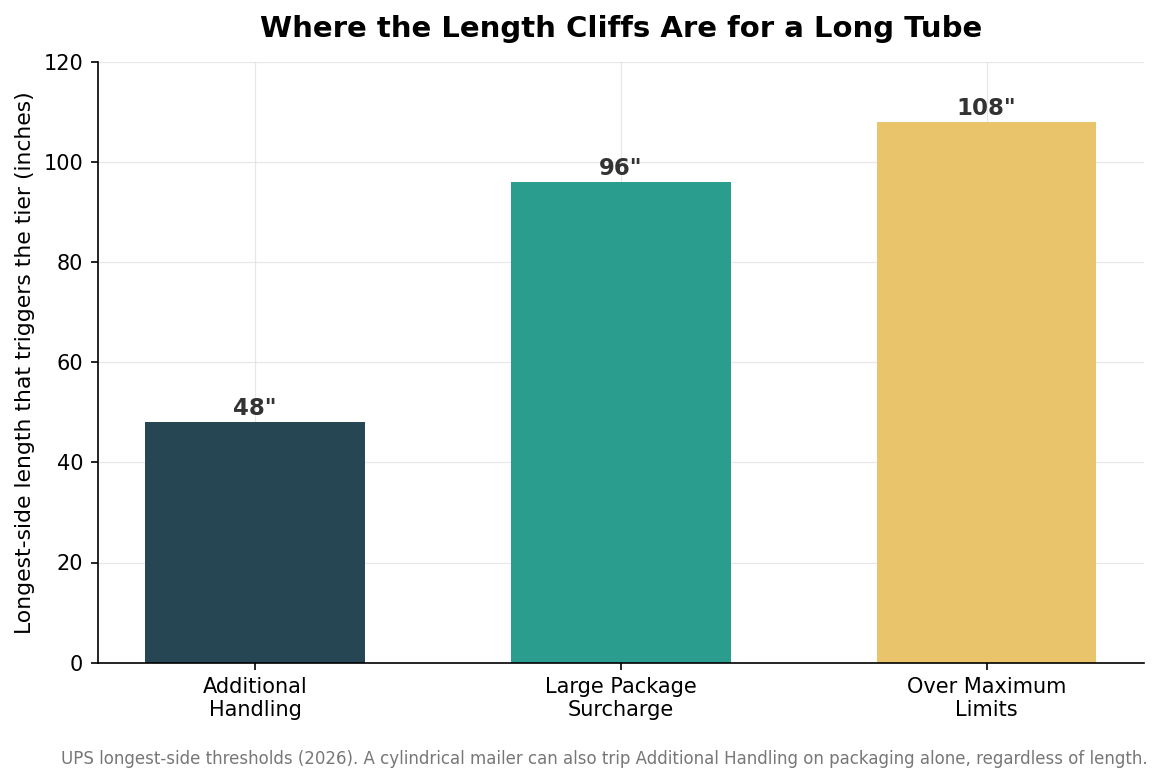
    Bar chart of UPS longest-side length thresholds: Additional Handling 48 inches, Large Package 96 inches, Over Maximum 108 inches
    The longest-side length at which each UPS surcharge tier begins; a cylinder can trip Additional Handling on shape alone.

    Above those thresholds sit two more tiers. The Large Package Surcharge triggers when the longest side passes 96 inches or length plus girth passes 130 inches, and it is a much steeper charge, commonly in the low hundreds of dollars per package. Beyond that, Over Maximum Limits begins at a 108-inch length or 165 inches of length plus girth and carries a flat penalty near 1,875 dollars, at which point the carrier may simply refuse the package. Girth here is measured as twice the width plus twice the height, so for a round tube it works out to about four times the diameter.

    What each surcharge actually costs

    Seeing the fees side by side clarifies where the money goes. The packaging and dimension charges cluster in the high twenties to mid thirties, while an overweight package, over 50 pounds, jumps to the mid forties or low fifties. Tubes almost never hit the overweight tier, which is the good news; their exposure is concentrated in the packaging and dimension charges, and those are the ones your spec can influence.
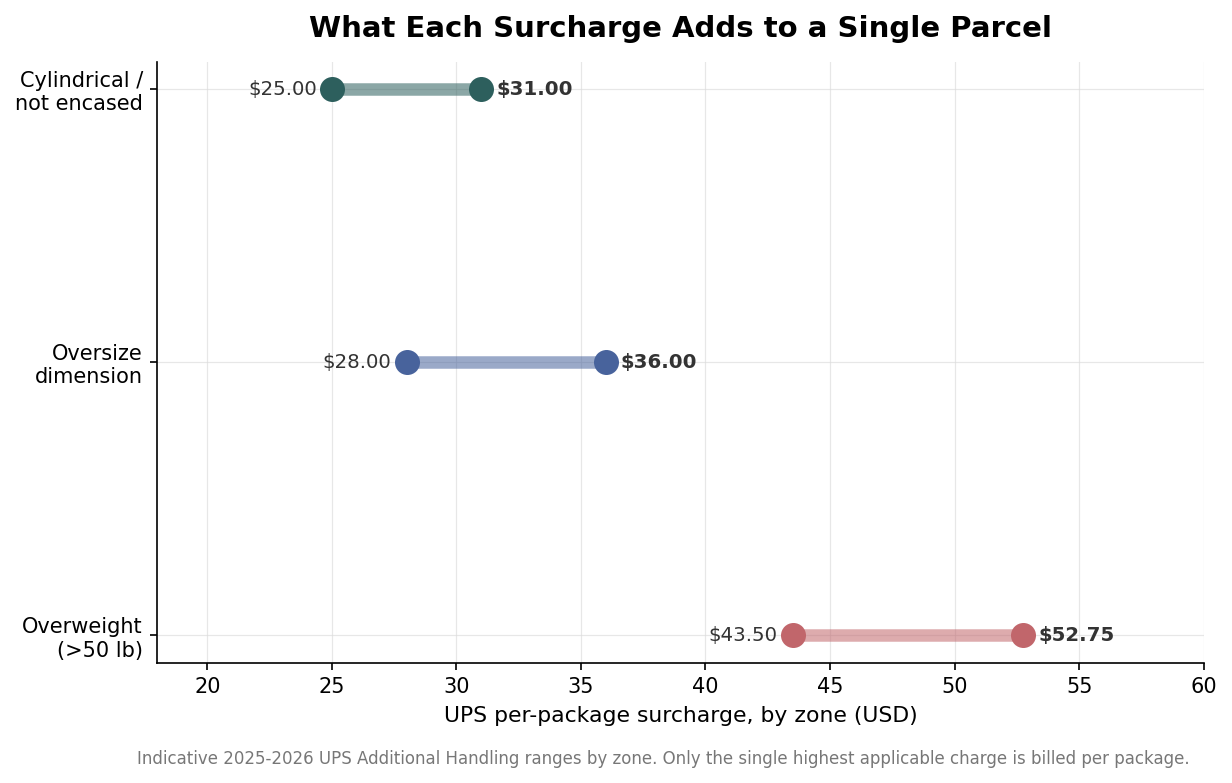
    Range chart of UPS per-package surcharges: cylindrical/not encased $25-31, oversize dimension $28-36, overweight $43.50-52.75
    Indicative UPS Additional Handling ranges by zone; only the single highest charge applies per package.

    Run the girth math and most tubes stay comfortably clear of the Large Package tier. A 37-inch tube with a 4-inch diameter has a length plus girth of about 53 inches, and even a fat 49-inch tube at 6 inches across lands near 73 inches, both far below the 130-inch line. In practice this means the realistic surcharge risk for standard poster and print tubes is Additional Handling, not the expensive oversize tiers, unless you are shipping unusually long architectural or banner tubes.

    FedEx mirrors this structure closely, with its own Additional Handling charges for dimension and packaging and an Oversize charge at comparable thresholds, so switching carriers rarely makes the shape penalty disappear. It is also worth noting what does not change the fee: end caps, wall thickness, and whether a tube telescopes are all quality and protection decisions, not surcharge decisions, because the carrier is reacting to the round outer format, not to how the tube is built. Dimensional weight is a separate calculation again, and for a slim tube it is usually low, so the surcharges, not billable weight, are where the cost surprises live.

    How to spec around it

    The first lever is length. If your contents allow it, keeping the longest side at or under 48 inches avoids the dimension version of Additional Handling, so a poster that can travel rolled a little tighter into a 44-inch tube ships cheaper than the same art in a 50-inch tube. Choosing a tube only as long as the contents demand, rather than rounding up to a stock size with room to spare, is the cheapest optimization available.

    The second lever is format. For flat items that are not too large, a rigid flat mailer made of corrugated sidesteps the cylindrical packaging rule entirely, because it is fully encased board rather than a tube, and it often nests and stores more efficiently too. Reserve tubes for pieces that genuinely need to travel rolled, such as large prints, and use flats where a stiff envelope protects the piece just as well. The third lever is verification: because the packaging surcharge depends on inspection, it is worth auditing a sample of your carrier invoices against what you expect, since misapplied or duplicated handling charges are common and refundable when caught. None of these moves the base rate, but together they keep a light, inexpensive tube from carrying a surcharge that dwarfs its own cost.
  • Mailing Tube vs. Flat Rigid Mailer: How to Ship Prints Without Damage

    Mailing Tube vs. Flat Rigid Mailer: How to Ship Prints Without Damage

    Anyone shipping prints, posters, or artwork eventually faces the same fork in the road: roll it into a mailing tube, or lay it flat inside a rigid stayflat mailer. Both are built to get a paper product to a customer uncreased, and both fail in different ways when they are specified badly. The right choice comes down to what you are shipping, how big it is, whether it can be rolled at all, and what the package has to survive on the truck. This is a spec-level comparison to help you pick the format and then dial in the dimensions.

    The short version: tubes win on structural strength and on shipping anything large, because a cylinder resists crushing and bending far better than a flat panel and a long print simply cannot travel flat without an enormous, expensive mailer. Flat rigid mailers win on convenience and on items that must not be rolled at all, up to a moderate size. Everything after this is about the numbers behind that trade-off.

    How each format protects the contents

    A tube protects by geometry. Rolled into a cylinder, cardboard gains hoop strength: the curved wall resists a crushing load and, critically, resists the bending and creasing that ruins a flat print in transit. That is why tubes are the default for valuable art, blueprints, and technical drawings — the shape itself is the protection, and it holds up under stacking in a trailer. The weak points of a tube are the ends, which is why end plugs and the way you cap the tube matter as much as the wall.

    A flat rigid mailer protects by stiffness. Heavy fiberboard panels keep a photo or unrolled print flat and resist casual bending, and the peel-and-seal closure makes them fast to pack. But a flat panel is more vulnerable to corner damage and to bending under heavy loads, especially as it gets larger, and the thin construction limits how much abuse it can take before a crease reaches the contents. For small, flat items that should never be rolled — photographic prints, certificates, single sheets — that is an acceptable trade. For anything large or high-value, the tube’s geometry is hard to beat.

    Wall thickness is the spec that actually matters

    With a tube, diameter gets all the attention but wall thickness determines whether the tube survives. Mailing-tube walls commonly run from about 0.060 to 0.080 inches for lightweight or local shipments, 0.080 to 0.120 inches for standard e-commerce, 0.120 to 0.180 inches for high-value or international parcels, and 0.180 inches and up for industrial use. In ply terms that is roughly two to three plies for thin, flexible walls and four to eight or more plies for rigid ones.

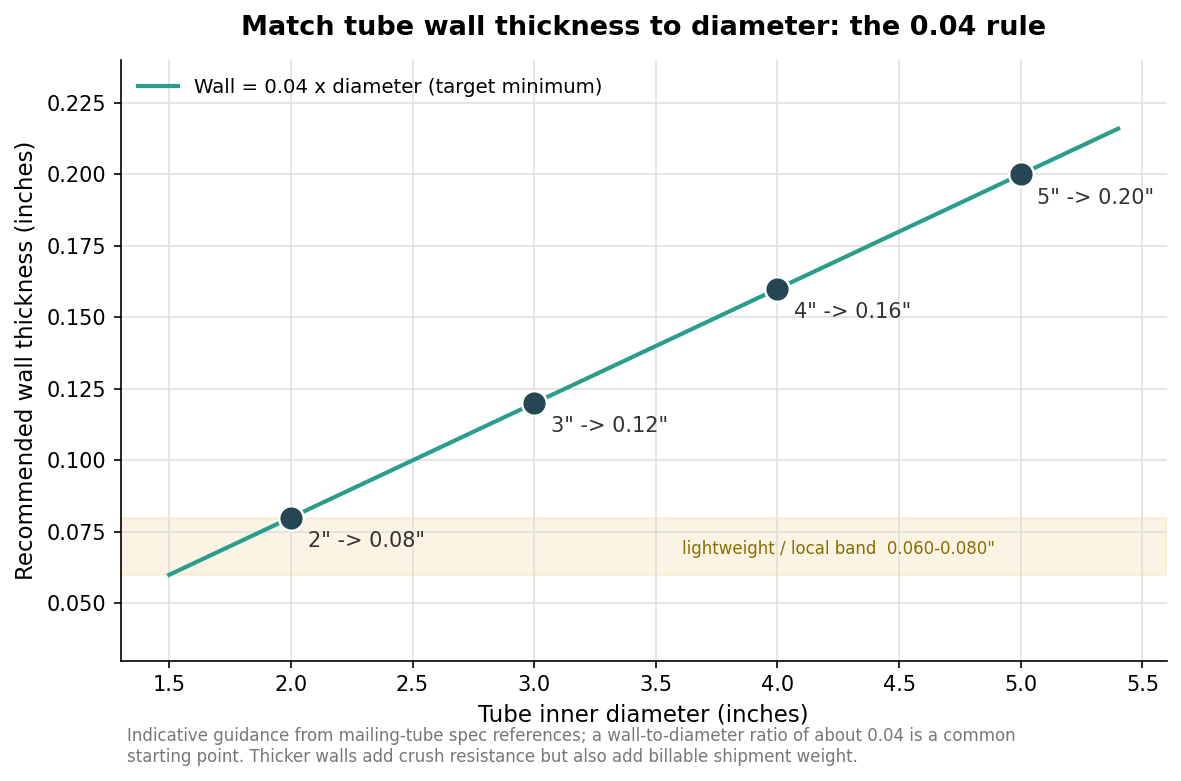
    A useful starting rule is to keep the wall thickness at least about four percent of the tube’s diameter — a wall-to-diameter ratio near 0.04. By that guide a three-inch tube wants a wall around 0.120 inches, and a four-inch tube around 0.160 inches, because a wider tube has a longer unsupported span across its diameter and needs a thicker wall to hold its shape under load. The catch is weight: every extra ply adds to the billable scale weight of the shipment, so over-speccing the wall quietly raises your per-parcel cost. Match the wall to the value and the journey, not to a worst case you will never see.

    Scatter chart plotting recommended mailing-tube wall thickness against tube inner diameter, following a wall-to-diameter ratio of about 0.04
    A wall-to-diameter ratio near 0.04 is a common starting point: a 3-inch tube wants roughly a 0.12-inch wall.

    Sizing the tube to the contents

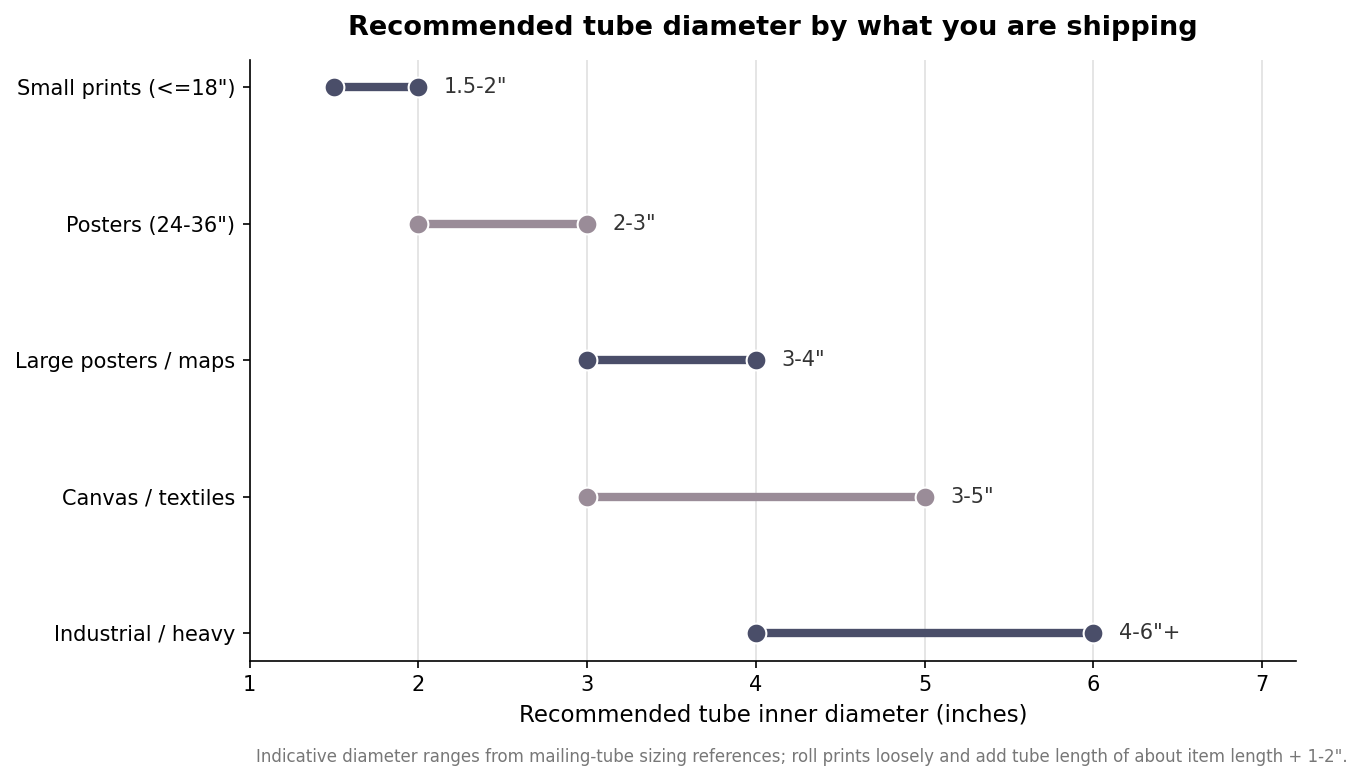
    Diameter should follow what you are rolling. Small prints up to about 18 inches roll comfortably into a 1.5 to 2 inch tube; standard posters in the 24 to 36 inch range want 2 to 3 inches; large posters and maps move up to 3 to 4 inches; canvas and textiles, which cannot be rolled tightly without damage, need 3 to 5 inches; and heavy industrial rolls start at 4 inches and climb. Rolling loosely into a larger diameter is gentler on the print than cramming it into the smallest tube that will technically hold it, and it reduces the memory curl the customer has to fight when they unroll it.

    Length is simpler: aim for the item length plus about one to two inches so the print sits inside the caps without being jammed, tightening to plus half an inch to one inch only when you want the snuggest possible fit, and allowing plus three inches for heavy industrial applications. Too much extra length lets the roll shift and telescope; too little forces the print against the end caps.

    Dumbbell dot plot of recommended mailing-tube inner diameter ranges by contents, from small prints at 1.5-2 inches to industrial rolls at 4-6 inches and up
    Recommended tube inner diameter by contents; roll prints loosely into the larger end of the range to reduce curl.

    Cost, dimensional weight, and carrier limits

    Cost comparisons between tubes and flat mailers are rarely about the packaging price alone; they are about how the carrier charges for the shape. Long tubes can trip length-based surcharges and non-standard package fees with the major carriers, and a large flat mailer can be billed on dimensional weight even when the contents weigh almost nothing. Before you standardize on a format, price a real parcel in both configurations with your actual carrier, because a package that looks cheaper to buy can be more expensive to ship every single day.

    As a practical matter, flat rigid mailers make sense from roughly 6 by 8 inches up to the low-to-mid twenties on a side — think 17 by 21 or 22 by 27 — where the panel is still stiff enough to matter and the parcel stays within normal mailer handling. Past that, the flat option gets unwieldy and vulnerable, and a tube becomes both stronger and easier to ship. If a print must never be rolled and it is larger than a mailer can safely carry, the honest answer is a rigid flat box with corner protection rather than an oversized stayflat.

    Choosing between them

    Start with one question: can the item be rolled? If it cannot — a mounted photo, a rigid certificate, a print the customer expects to arrive dead flat and small — use a flat rigid mailer and keep it within a size the panel can actually protect. If it can be rolled, and especially if it is 24 inches or longer or genuinely valuable, use a tube and spec the wall to the diameter using the 0.04 guideline. Choose the diameter from the contents, add an inch or two of length, and cap the ends properly. Get those few numbers right and either format will deliver an uncreased print; get them wrong and you will pay for it in damage claims, reprints, or shipping surcharges that never show up until the invoice.

  • Round vs. Triangular Mailing Tubes: A Spec Comparison

    Round vs. Triangular Mailing Tubes: A Spec Comparison

    When you order mailing tubes for prints, posters, blueprints, or rolled textiles, the first fork in the road is shape. Almost every catalog offers a familiar round tube and a triangular one, often at a similar price, and the listing rarely explains why you would pick one over the other. The two protect a rolled item about equally well, but they behave very differently once they hit a warehouse shelf, a conveyor belt, and a carrier’s rate table. Here is a spec-by-spec comparison to help you match the tube to how you actually ship.

    The shape difference shows up on the loading dock

    Round tubes are spiral-wound from kraft paperboard, typically two or three plies thick, with a wall in the rough range of 0.06 to 0.09 inches depending on grade. They arrive rigid and ready, close with plastic end caps that press or twist into place, and stack into cylindrical nests that waste some shelf space. Their defining habit is that they roll. On a sortation conveyor a round tube can drift, turn, and present its label at an angle that a scanner struggles to read.

    Triangular tubes are cut and scored from corrugated fiberboard, commonly a 200-pound B-flute board in kraft or oyster white, and they ship to you flat. You fold them into a three-sided prism and close the ends with locking tabs, so no tape or plastic cap is required. The flat panels are the whole point: a triangle sits still on a belt, interlocks with its neighbors in a truck or on a pallet, and stores as flat blanks that take a fraction of the space of pre-formed round tubes. For a fulfillment operation running automated label scanning, a package that will not roll is a measurable convenience.

    Strength, closures, and protecting the contents

    On raw protection there is less daylight between the two than vendors imply. A rolled poster inside either style is cushioned by the air gap around it and the stiffness of the wall, and most suppliers describe their round and triangular lines as comparable in bending and crush resistance for the same board weight. The triangle earns its strength from geometry: three flat panels meeting at reinforced edges resist flexing without needing a heavier wall, which is why a triangular tube can weigh less than a round tube of similar capacity while surviving the same handling.

    The closures diverge in a way worth thinking about. Round tubes with reusable twist-off or pull caps are the better choice when the recipient will open and reclose the tube repeatedly, such as a rolled document that lives in the tube between uses. Triangular tubes with locking tabs are built to be sealed once and opened once; they excel as a one-way shipper but are not meant for repeated reuse. If your product is a keepsake print that a customer stores rolled, the reusable round cap has real end-user value. If it is a poster headed out the door to be unrolled and framed, the tape-free locking triangle saves a packing step.

    What each style costs to buy, and to ship

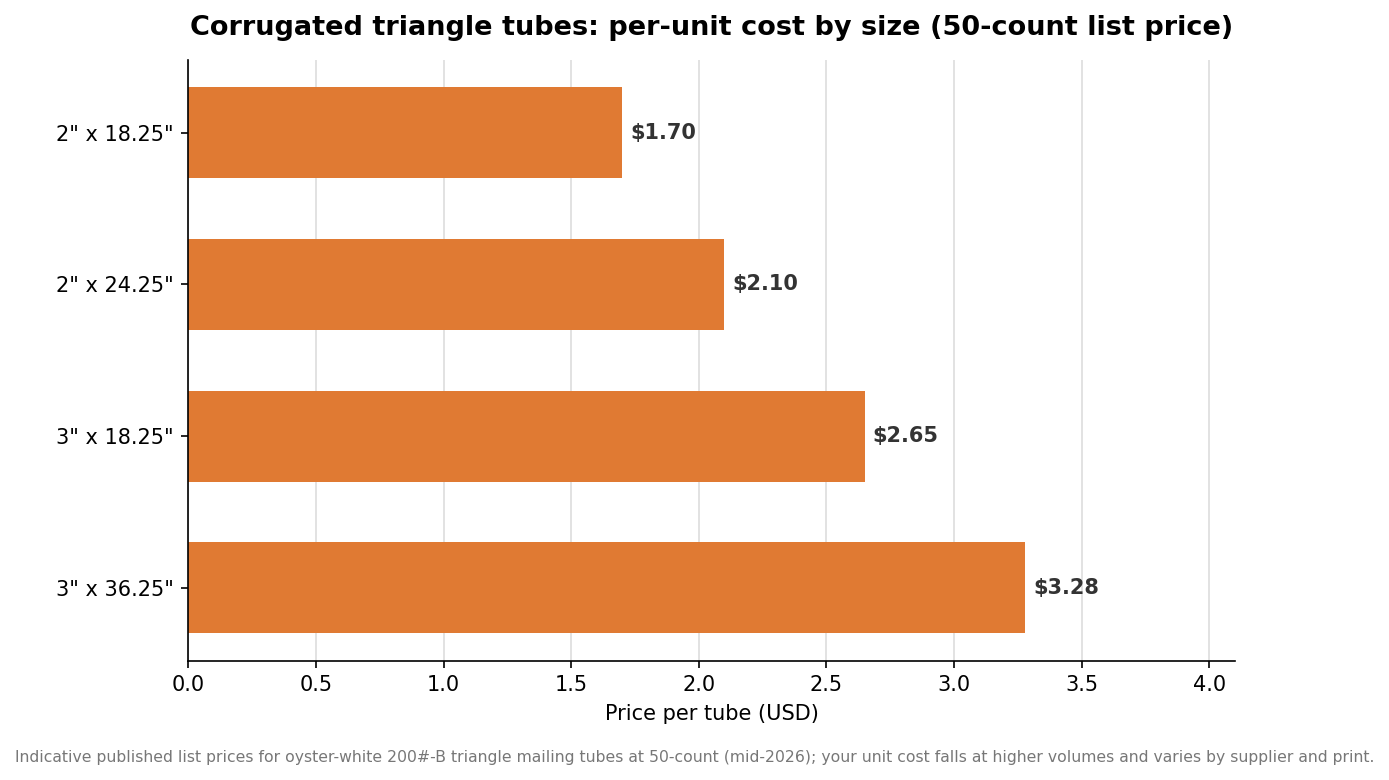
    Purchase price tracks size and board more than shape. Corrugated triangle tubes in common sizes land in the low single digits per unit at modest quantities, as the published list prices below show, and per-unit cost drops as you move into thousands. Round kraft tubes occupy a similar band, with the plastic end caps adding a few cents per pair. Neither shape has a decisive purchase-cost advantage; the real money is on the shipping side.

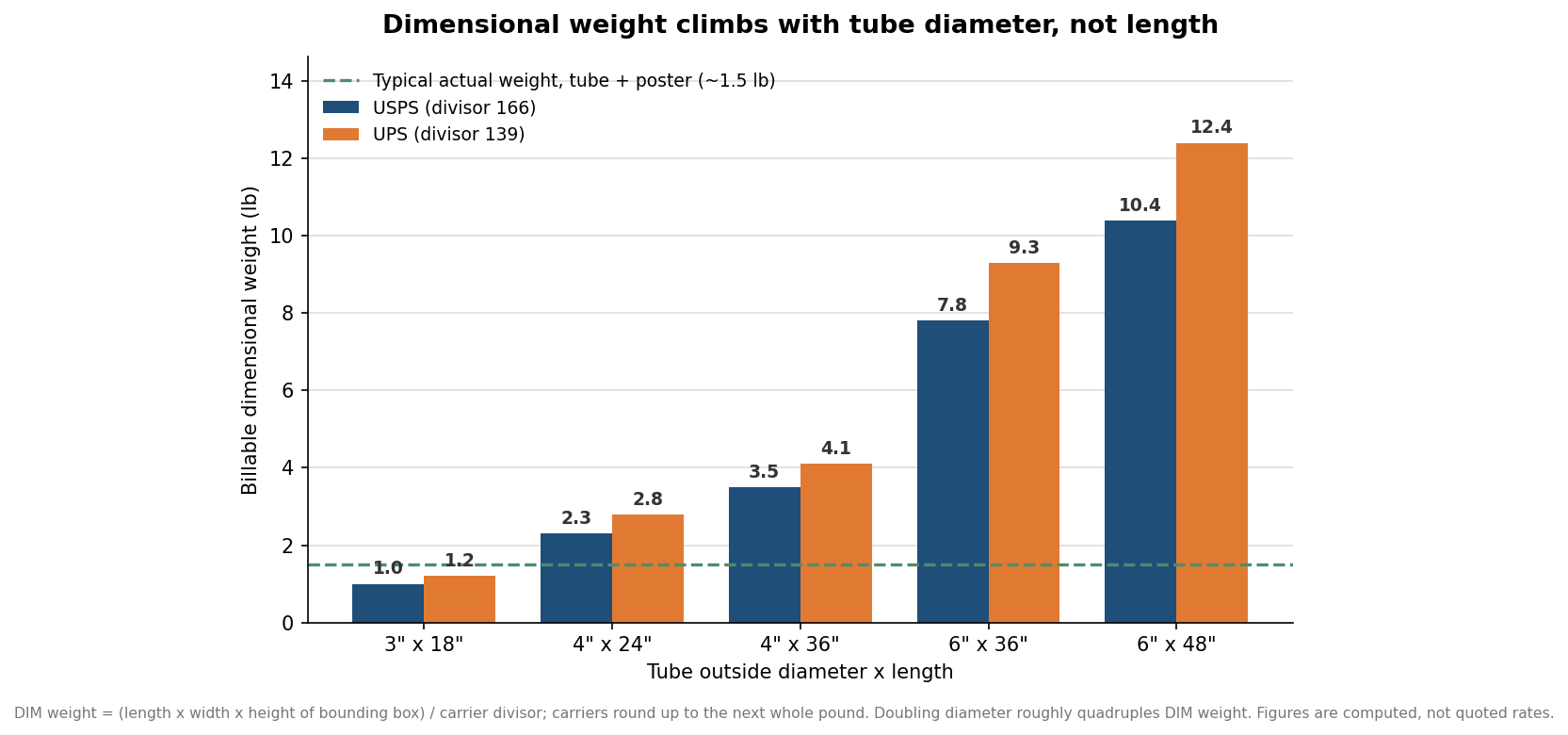
    Dimensional weight is where tube choice quietly moves your postage. Carriers bill the greater of a parcel’s actual weight and its dimensional weight, which is the volume of the bounding box divided by a divisor: USPS uses 166 and applies dimensional pricing once a parcel exceeds one cubic foot, or 1,728 cubic inches, while UPS uses a tighter 139. Because a tube is priced on the rectangular box that contains it, the diameter matters far more than most shippers expect. A rolled poster is light, often well under two pounds packed, so once a tube is large enough its dimensional weight, not the poster, sets the rate.

    Grouped bar chart of USPS and UPS dimensional weight for five tube sizes, rising sharply with diameter
    Dimensional weight rises with the square of tube diameter, so wide tubes bill far above a light poster’s actual weight.

    The pattern in that chart is the single most useful spec insight for tubes: doubling the diameter roughly quadruples dimensional weight, because the bounding box grows with the square of the width. A six-inch tube can bill at ten pounds or more on a poster that actually weighs one, while a three-inch tube for the same length stays near a single pound. The practical rule is to choose the smallest inside diameter that lets the contents roll without creasing, and to resist the temptation to size up for margin. Length drives dimensional weight far less, though it triggers a separate set of concerns: USPS treats greater lengths as nonstandard and adds handling fees at length thresholds that have sat around 22 and 30 inches in recent rate tables, and beginning with the July 12, 2026 phase of its dimension rules, parcels over one cubic foot or longer than 22 inches face a roughly three-dollar noncompliance fee when dimensions are missing or wrong. Enter accurate dimensions on every label regardless of which tube you pick.

    Print surface and brand presentation

    If the tube is part of the unboxing, the triangle has the better canvas. Its flat faces take crisp flexographic or litho-label printing edge to edge, with no curvature to distort a logo or type, and three distinct panels give you room for a brand mark, a message, and handling instructions without crowding. A round tube prints well too, but the curved surface limits how a design reads from a single viewpoint and makes precise registration harder. For a plain shipper where nobody but the sorter sees the outside, this is moot and the round tube’s simplicity wins. For a retail-facing or gift presentation, the triangle’s flat panels are a genuine advantage.

    How to choose

    Match the tube to the dominant constraint. If your items are reused and stored rolled, or you value the simplest possible pre-formed shipper, the round tube with a reusable cap is the straightforward pick. If you ship through automated fulfillment, want tubes that store flat and will not roll off a belt, care about branded flat panels, or are trimming every ounce of dimensional weight, the triangular tube rewards the switch. Across both shapes, the decision that saves the most money is diameter discipline: size the tube to the contents, keep the width down, and let the chart above remind you why a slightly snugger tube ships for so much less.

    Horizontal bar chart of per-unit prices for four corrugated triangle mailing tube sizes
    Per-unit list prices for common corrugated triangle tube sizes at 50-count; unit cost falls at higher volumes.

    Whichever shape you land on, order a small sample run, roll your actual product into it, and weigh and measure the packed tube before you commit to thousands. The bounding-box math and the closure feel are much easier to judge with a real tube in hand than from a catalog line, and a ten-minute test protects both your contents and your shipping budget.

  • Five Mistakes That Wreck a Custom Shipping Tube Order

    Five Mistakes That Wreck a Custom Shipping Tube Order

    A shipping tube looks like the simplest package a brand can buy: a cardboard cylinder and two caps. That simplicity is exactly why the ordering mistakes are so common and so expensive. The errors do not show up in the proof or the first sample. They show up weeks later as crushed corners, popped-off caps, contents that arrive with a permanent curl, or an invoice with an oversize surcharge no one expected. Almost all of them trace back to five decisions made too quickly at the specifying stage. Here is where custom tube orders go wrong, and how to get each one right.

    Mistake 1: Confusing inner diameter with outer diameter

    The single most common tube error is ordering by the wrong diameter. Tubes are specified by inner diameter, the usable space your rolled contents sit inside, but shipping is measured by outer diameter, the wall-to-wall width the carrier uses to figure girth and dimensional weight. Ask a supplier for a “3-inch tube” without saying which number you mean and you may receive a tube whose 3-inch measurement is the outside, leaving an inside too tight for the print you meant to roll. Order by inner diameter, match that inner diameter to what you are actually rolling, and remember that the outer diameter is inner diameter plus twice the wall thickness.

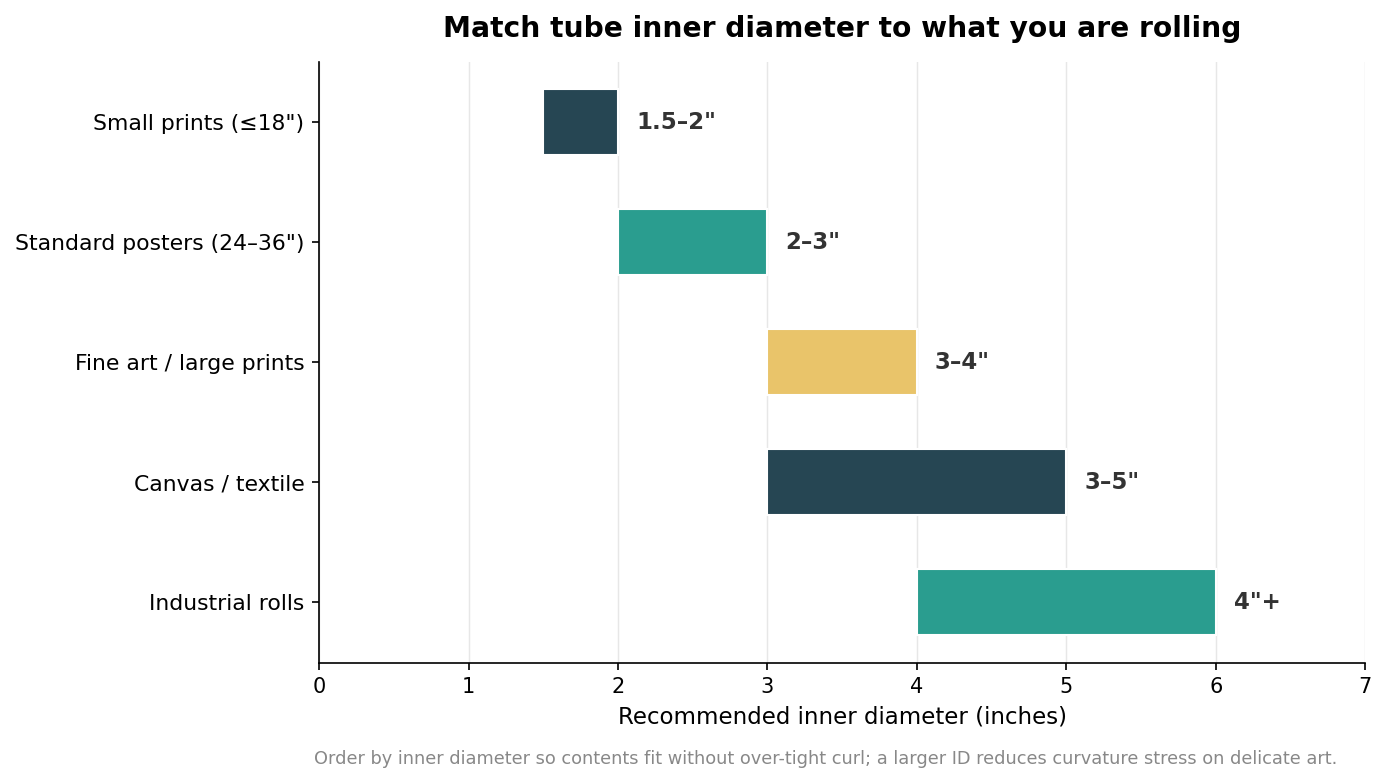
    Horizontal bar chart of recommended inner diameter by content type, from 1.5-2 inches for small prints to 4 inches and up for industrial rolls
    Recommended inner diameter by what you are rolling; order by inner diameter, not the outside measurement.

    The chart gives defensible starting points: roughly 1.5 to 2 inches for small prints, 2 to 3 inches for standard 24 to 36 inch posters, and 3 inches and up for fine art, canvas, and textiles that crack or crease when forced into a tight curl. A larger inner diameter reduces the curvature stress on delicate material, which is why premium art rarely ships in a narrow tube even when it would physically fit.

    Mistake 2: Under-speccing the wall thickness

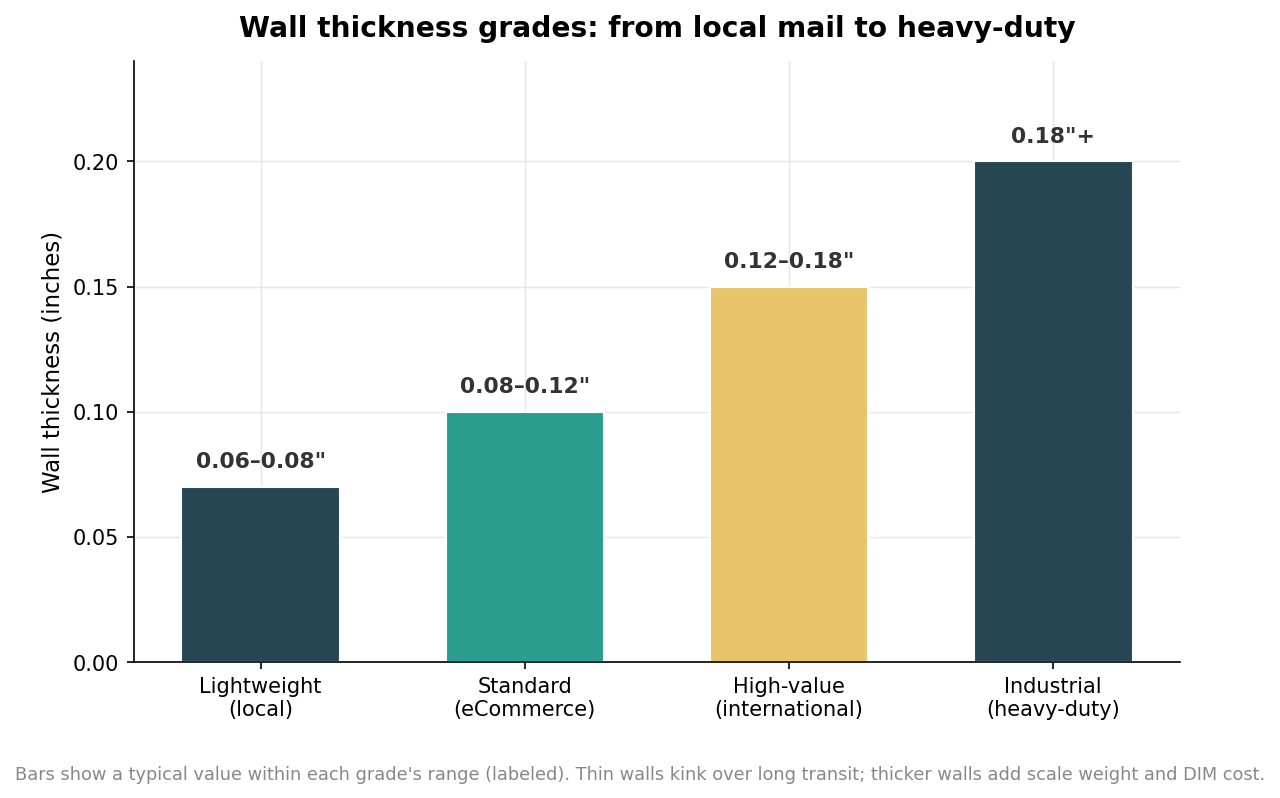
    The second mistake is choosing wall thickness by price alone. A thin wall costs less and weighs less, but thin-walled tubes kink and collapse over long transit, and a kinked tube transmits the damage straight to the contents. Mailing tube walls fall into recognizable grades: about 0.06 to 0.08 inch for lightweight local mail, 0.08 to 0.12 inch for standard eCommerce posters and retail prints, 0.12 to 0.18 inch for high-value or international shipments, and 0.18 inch and up for industrial heavy-duty use.

    Bar chart of mailing tube wall thickness grades from 0.06-0.08 inch lightweight to 0.18 inch-plus industrial
    Wall thickness grades from local mail to heavy-duty; thin walls kink in transit, thick walls add shipping weight.

    The trade-off runs both directions. Too thin and the tube fails on a cross-country journey through automated sortation; too thick and you are paying for board weight that adds to the scale weight and, on a large tube, to the dimensional weight the carrier bills. Match the grade to the value of the contents and the distance they travel, rather than defaulting to the cheapest wall to shave a few cents a unit.

    Mistake 3: Sizing the length with no clearance

    Length errors cut both ways. Order a tube exactly as long as the contents and there is no room for the end caps to seat properly, so the caps bulge, the closure strains, and the ends crush first. A workable rule is to add roughly one to two inches to the length of the rolled item for a safe fit, and about three inches for heavy industrial rolls that need room to move. Erring long has its own cost, though: carriers apply oversize or nonstandard fees once a package passes length thresholds in the range of 22 to 30 inches, and international shipments crossing about 36 inches can jump from standard parcel pricing into freight. The goal is the shortest tube that still leaves clearance for the caps, not the longest tube that happens to be in stock.

    Mistake 4: Treating end caps as an afterthought

    Caps are where a tube actually fails in the field, yet they are usually the last thing specified. A plain friction-fit plastic cap is fine for light, low-value contents moving a short distance, but under rough handling those caps work loose and pop off, and a tube open at one end delivers a crushed or empty package. For anything valuable, long, or heavy, step up to a stapled closure or a locking cap that twists or snaps into place and cannot be jostled off. It is also worth confirming the cap fits the specific wall and diameter you ordered, because a cap sized for a different wall thickness either falls out or refuses to seat. The cap is not an accessory to the tube; it is half of what keeps the contents inside.

    Mistake 5: Designing artwork that ignores the tube

    The last mistake is treating a tube like a flat sheet. Print wraps around a cylinder, so a design has a seam where the wrap meets, and artwork that ignores that seam ends up with a logo split across it or a pattern that visibly jumps. Curvature also means only part of the print faces the customer at any moment, so the key brand elements should repeat around the tube rather than sitting in one spot. Decide early whether the end caps are a matching color or a contrasting accent, keep critical text away from the seam and the capped ends, and extend any background fully to the edges so a slight shift on the wrapping line does not expose bare kraft. A tube that is specified correctly and printed with its shape in mind arrives intact and on-brand, which is the entire point of paying to customize it in the first place.

  • USPS Rules for Poster and Mailing Tubes: Sizes and Surcharges

    USPS Rules for Poster and Mailing Tubes: Sizes and Surcharges

    A mailing tube looks like the cheapest way to ship a rolled poster or print, right up until the carrier adds a surcharge you did not price in. The reason is structural: tubes are long and round, which is exactly the shape postal automation dislikes, so the U.S. Postal Service treats them differently from a compact box. Knowing where the fee thresholds sit lets you choose a tube length and a service that keep the shipment cheap instead of quietly bleeding a few dollars on every order. Here is how USPS actually measures and prices a tube, and where the money leaks out.

    How USPS measures a tube

    Every parcel is judged on two figures: its longest side and its combined length plus girth. For a rectangular box, girth is twice the width plus twice the height. For a cylinder it is simpler and often misjudged, because girth is just the circumference, which is pi times the diameter. A three-inch-diameter tube has a girth of only about 9.4 inches, and a four-inch tube about 12.6 inches. Add that to the length and most tubes sit far below the ceiling: the standard maximum combined length plus girth is 108 inches for services like Ground Advantage and Priority Mail, with an oversized tier running up to 130 inches, beyond which a piece is generally nonmailable and refused. Because a tube’s girth is so small, you will almost never bump the 108-inch limit with a poster tube. As an example, a 36-inch tube of four-inch diameter totals only about 48.6 inches of length plus girth, less than half the ceiling, which shows how much headroom the round shape leaves on that particular limit. Tubes are also capped at 70 pounds like other parcels, though rolled paper rarely approaches that. The length, not the girth or the weight, is what triggers the fees.

    The length surcharges that catch tube shippers

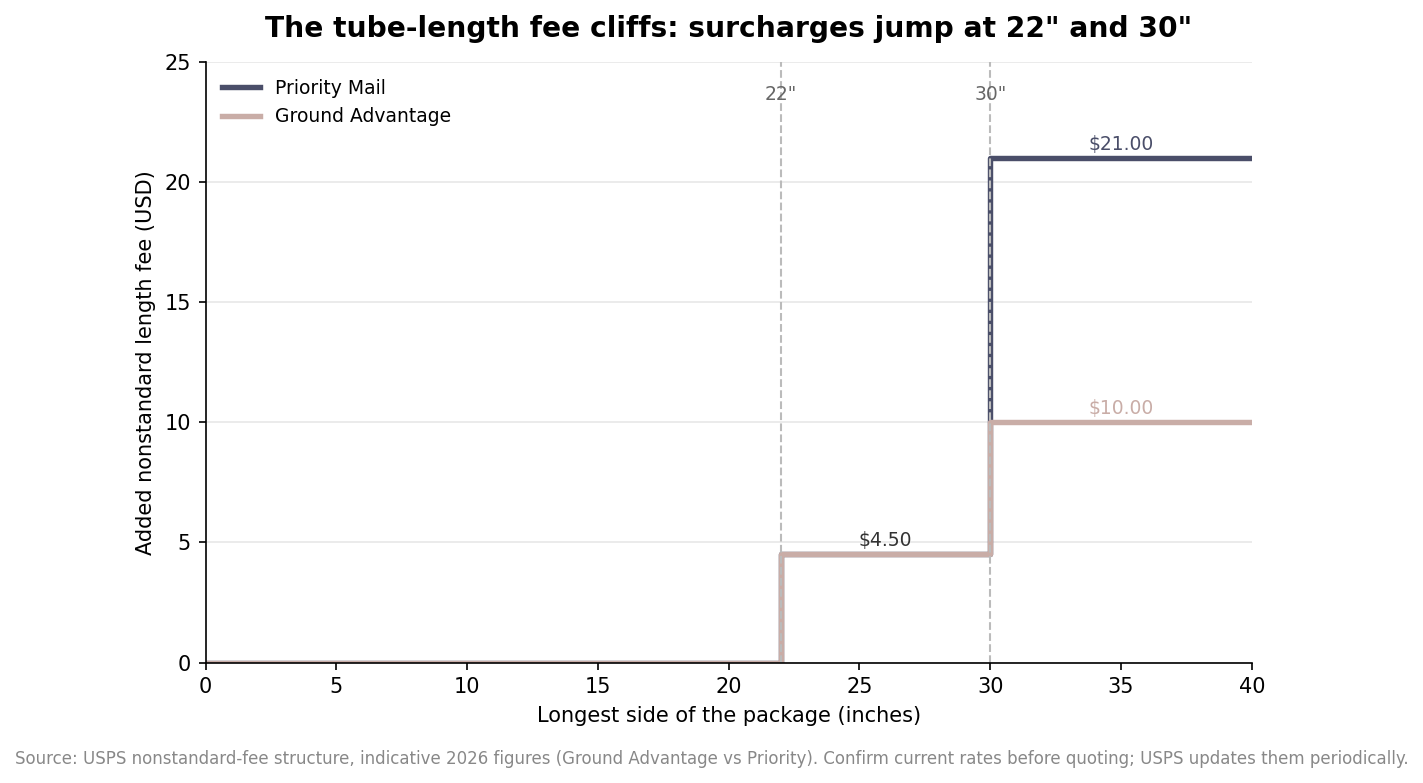
    USPS applies a nonstandard fee based on the single longest dimension, and it steps up twice. As of 2026 the first step lands when the longest side passes 22 inches, adding roughly $4.50 on both Ground Advantage and Priority Mail. The second step lands past 30 inches, where the surcharge climbs to about $10 on Ground Advantage and around $21 on Priority Mail. The jump between services matters here: a long tube that crosses 30 inches is penalized far more heavily on Priority than on Ground, so the cheaper service can stay cheaper by a wide margin once you factor the surcharge in. These are indicative 2026 figures; USPS revises them periodically, so confirm the current amounts before you build them into a shipping quote.

    Step chart of USPS nonstandard length surcharges rising at 22 inches and 30 inches for Ground Advantage versus Priority Mail
    USPS length surcharges step up at 22 and 30 inches, and Priority’s top tier costs far more than Ground’s.

    The reason this catches so many sellers is that the poster or print inside sets a floor on the tube length. A rolled 24-by-36-inch poster needs a tube at least a little longer than 24 inches, which already clears the first threshold, and anything shipping a 36-inch or larger print pushes past the second. You are paying the surcharge before you ever print your logo on the tube.

    Where common tube lengths actually fall

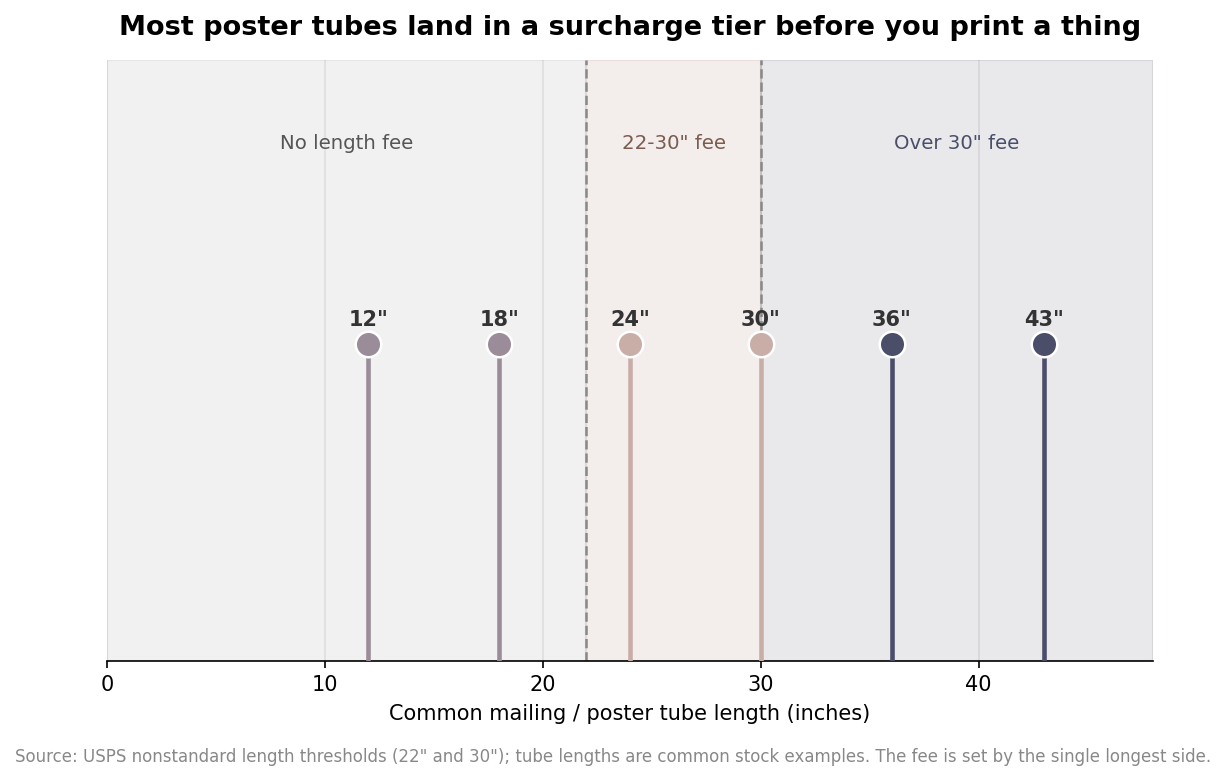
    Stock mailing tubes cluster around a handful of lengths, and it is worth seeing which tier each one lands in. Short tubes of 12 to 18 inches, used for small prints, documents, and rolled apparel, stay under 22 inches and dodge the length fee entirely. The moment you move to a 24-inch tube for a standard poster, you enter the first surcharge band, and the popular 36- and 43-inch tubes for large-format prints and blueprints sit squarely in the highest band.

    Number line showing common mailing tube lengths from 12 to 43 inches sorted into the no-fee, 22-to-30-inch, and over-30-inch surcharge tiers
    Common tube lengths mapped against the two USPS length-fee thresholds.

    The practical takeaway is to buy the shortest tube that still protects the contents rather than defaulting to an oversized one. Trimming a tube from 25 inches to under 22, when the artwork allows a tighter roll, removes a fee on every single unit. When the print genuinely is large, accept that the surcharge is coming and choose the service where it costs the least.

    The other fees and rules to know

    Length is the big one, but a few other charges stack on top. Tubes can also draw a nonstandard characteristics fee, roughly $4.50 as of 2026, applied because their shape is awkward for automated handling regardless of size. Parcels exceeding two cubic feet, which is 3,456 cubic inches, pick up an additional volume fee, though a slim tube rarely reaches that. There is also a small fee for shipments sent without dimensions, so declaring accurate measurements in your shipping software is worth the habit. Media Mail is exempt from these nonstandard fees, but most posters, art prints, and marketing materials do not qualify as Media Mail, which is reserved for educational media, so do not assume that exemption applies to a promotional print.

    How to keep tube shipping affordable

    Start by matching the tube length to the tightest safe roll of the contents, because every inch you can shave below a threshold is money back on each shipment. Compare services deliberately: for a long tube over 30 inches, Ground Advantage often wins once the heavier Priority surcharge is included, unless you specifically need the faster transit. Weigh whether a flat, rigid photo mailer beats a tube for smaller prints that can ship unrolled and stay under 22 inches on the longest side, since a flat piece avoids the round-shape penalties altogether. Finally, treat the dollar figures in this guide as a planning framework rather than a live rate sheet; the thresholds of 22 and 30 inches and the 108-inch combined limit are stable, but the exact surcharge amounts change with each USPS pricing update, so verify them against the current published rates before you commit a season of orders to one tube size.

  • How Many Custom Shipping Tubes Should You Order?

    Call or Text us: (929) 605-4397
    ection class=”section section–cream”>

    Home › Blog › How Many Custom Shipping Tubes Should You Order?

    Ordering

    How Many Custom Shipping Tubes Should You Order?

    07/01/2026

    Ordering custom shipping tubes for the first time, most shops either overbuy on a size they’ll refine or underbuy and miss the price break — and both waste money. Because printed tubes carry a setup cost, the per-unit price falls sharply with volume, so order size is an economic decision as much as a usage one.

    Here’s how to size an order once you split your shipping into its real patterns.

    One-time drop: count sends, add a buffer

    For a limited poster or print drop, order your expected sends plus 10–15% for damages, reprints, and samples. The buffer is cheaper than a rushed second run, and printed tubes keep for the next release.

    Ongoing fulfillment: order to a tier, replenish on trigger

    If you ship continuously, order enough to hit a real price tier — the setup cost makes 500 far more expensive per unit than 5,000 — then set a reorder trigger at about 3 weeks of cover. We keep your specs on file, so reorders are fast and exact.

    Multiple sizes: consolidate the order

    If you ship several tube sizes, order them in one production window to share setup and hit a higher combined tier, lowering the price on every size at once — or standardize on a telescoping tube to cut SKUs entirely.

    PatternStarting quantityWhy
    One-time dropSends + 10–15%Covers damage, reprints, samples
    Ongoing fulfillmentOrder to a real tierSetup cost dominates at low volume
    Multiple sizesConsolidate into one orderShares setup, hits higher tier
    Key takeaway

    Quantity is the biggest lever on per-tube cost: once your size and artwork are set, ordering up one tier usually pays for itself.

    Tell us your tube size and volume and we’ll show you where the price tiers fall — with a free mockup, within one business day.

    More posts

    GET A QUOTE
  • Kraft vs. White Shipping Tubes: Which to Choose

    Call or Text us: (929) 605-4397
    ection class=”section section–cream”>

    Home › Blog › Kraft vs. White Shipping Tubes: Which to Choose

    Buyer Guides

    Kraft vs. White Shipping Tubes: Which to Choose

    06/17/2026

    The two base tubes are natural kraft and white, and they send different signals before a single word of print is read. Choosing between them is mostly about the impression you want the delivery to make and how your artwork reproduces.

    Here’s how the two compare.

    Kraft: honest, eco, economical

    Natural kraft reads recyclable, utilitarian, and honest, and it’s the more economical base. It suits everyday shipping, eco-forward brands, and spot-color logos that look great against brown. What it won’t do is reproduce full-color artwork as vividly as white.

    White: premium, full-color, retail

    A white tube is the better canvas for full-color wraps, foil, and photographic artwork, and it reads more premium and retail. Choose it for fine-art prints, gift packaging, and any send where the unboxing supports a higher perceived value. It costs a little more than kraft.

    How to decide

    If the tube is a functional shipper for an eco or utilitarian brand, go kraft. If the tube is part of a premium product experience or carries full-color artwork, go white. Many brands run kraft for volume and white for premium SKUs.

    FactorKraftWhite
    CostLowerHigher
    Color reproductionGood for spot colorBest for full color / foil
    ImpressionHonest, eco, utilitarianPremium, retail, gift
    Key takeaway

    Rule of thumb: kraft for the workhorse send, white for the premium or full-color one. You can run both and mix them in a single order.

    Send your artwork and we’ll mock it up on both kraft and white so you can compare — free, within one business day.

    More posts

    GET A QUOTE
  • How to Size a Shipping Tube for Your Contents

    Call or Text us: (929) 605-4397
    ection class=”section section–cream”>

    Home › Blog › How to Size a Shipping Tube for Your Contents

    Buyer Guides

    How to Size a Shipping Tube for Your Contents

    06/03/2026

    The most common shipping-tube mistake is the wrong size — a tube too wide lets contents shift and dent, a tube too tight is hard to load and can crease the contents, and a wall too thin crushes. Getting the three dimensions right is what makes the difference between arrivals and claims.

    Here’s how to size a tube for your contents.

    Diameter: match the roll

    Roll your contents as tightly as they’ll comfortably go, measure that diameter, and add a small clearance so it loads easily without flopping around. Too much clearance invites movement and damage; too little makes packing slow and risks creasing. When in doubt, send us the item.

    Length: flat dimension plus clearance

    The tube length should equal the contents’ flat dimension plus a little room for the caps and handling. Cutting tubes to length — which we do — beats forcing contents into a stock size or leaving them rattling in an oversized one.

    Wall thickness: match the value and weight

    Standard walls protect posters and prints; heavy-duty walls protect long, heavy, or irreplaceable contents. The heavier or more valuable the send, the thicker the wall and the more secure the cap should be.

    Key takeaway

    The safest tube is a snug one: match the diameter and length to the contents and the wall to their value, and damage claims drop sharply.

    Tell us what you’re shipping — or send the item’s rolled size — and we’ll spec the exact tube, with a free mockup within one business day.

    More posts

    GET A QUOTE
  • The Best Way to Ship Posters and Prints Without Damage

    Call or Text us: (929) 605-4397
    ection class=”section section–cream”>

    Home › Blog › The Best Way to Ship Posters and Prints Without Damage

    Posters

    The Best Way to Ship Posters and Prints Without Damage

    05/20/2026

    A creased corner or a crushed tube turns a beautiful poster into a refund. Posters and prints are among the most damage-prone things to ship, but the right tube and a few packing habits get them to the door pristine — and turn the delivery into a branded moment.

    Here’s how to ship posters and prints without damage.

    Roll and protect the print

    Roll prints with the image facing out on a slightly larger diameter to avoid tight creases, or interleave with tissue for fine art. Never fold. A snug roll that fills the tube diameter resists movement, which is the main cause of in-transit creasing.

    Choose the right tube and caps

    Use a rigid tube sized to the rolled diameter with secure end caps; for valuable or large-format prints, step up to a heavy-duty tube with locking caps. A tube that holds its shape under stacked parcels is what keeps the contents flat.

    Brand the delivery

    A printed tube makes the unboxing part of the product — a full-color wrap or a foil logo signals quality before the customer even opens it. For print shops and artists, that branded arrival is a low-cost marketing win on every order.

    Key takeaway

    The two things that prevent poster damage: a snug tube sized to the rolled diameter, and secure caps that don’t pop in transit.

    Tell us your poster size and volume and we’ll spec a protective, branded tube — with a free mockup within one business day.

    More posts

    GET A QUOTE
  • Using Shipping Tubes as Premium Gift Packaging

    Call or Text us: (929) 605-4397
    ection class=”section section–cream”>

    Home › Blog › Using Shipping Tubes as Premium Gift Packaging

    Retail

    Using Shipping Tubes as Premium Gift Packaging

    05/06/2026

    Tubes aren’t just for posters. A well-finished tube makes a striking gift package — distinctive, protective, and full of unboxing drama — for everything from spirits to apparel to specialty goods. Brands are increasingly reaching for tubes precisely because they stand out on a shelf and in a photo.

    Here’s how to use tubes as premium gift packaging.

    Pick a shape with presence

    A square tube presents flat printed panels and won’t roll, a white round tube reads clean and premium, and a heavy paperboard tube feels substantial in the hand. The shape sets the tone before the print does — choose one that matches the product’s positioning.

    Finish it like a gift

    Full-color wraps, foil stamping, and interior printing turn a tube into a considered package. A foil logo on a white or dark tube, a printed message revealed inside, and matched end caps all elevate the moment the customer opens it.

    Make it shareable

    Distinctive tube packaging photographs well, which turns customers into content. For DTC and gifting brands, an unboxing worth posting is earned reach — the packaging pays for itself in impressions.

    Key takeaway

    A tube’s advantage as gift packaging is drama: the reveal of sliding out the contents is an unboxing moment a flat box can’t match.

    Tell us your product and we’ll design a giftable tube — square, white, or foil-finished — with a free mockup within one business day.

    More posts

    GET A QUOTE