A mailing tube looks like the cheapest way to ship a rolled poster or print, right up until the carrier adds a surcharge you did not price in. The reason is structural: tubes are long and round, which is exactly the shape postal automation dislikes, so the U.S. Postal Service treats them differently from a compact box. Knowing where the fee thresholds sit lets you choose a tube length and a service that keep the shipment cheap instead of quietly bleeding a few dollars on every order. Here is how USPS actually measures and prices a tube, and where the money leaks out.
How USPS measures a tube
Every parcel is judged on two figures: its longest side and its combined length plus girth. For a rectangular box, girth is twice the width plus twice the height. For a cylinder it is simpler and often misjudged, because girth is just the circumference, which is pi times the diameter. A three-inch-diameter tube has a girth of only about 9.4 inches, and a four-inch tube about 12.6 inches. Add that to the length and most tubes sit far below the ceiling: the standard maximum combined length plus girth is 108 inches for services like Ground Advantage and Priority Mail, with an oversized tier running up to 130 inches, beyond which a piece is generally nonmailable and refused. Because a tube’s girth is so small, you will almost never bump the 108-inch limit with a poster tube. As an example, a 36-inch tube of four-inch diameter totals only about 48.6 inches of length plus girth, less than half the ceiling, which shows how much headroom the round shape leaves on that particular limit. Tubes are also capped at 70 pounds like other parcels, though rolled paper rarely approaches that. The length, not the girth or the weight, is what triggers the fees.
The length surcharges that catch tube shippers
USPS applies a nonstandard fee based on the single longest dimension, and it steps up twice. As of 2026 the first step lands when the longest side passes 22 inches, adding roughly $4.50 on both Ground Advantage and Priority Mail. The second step lands past 30 inches, where the surcharge climbs to about $10 on Ground Advantage and around $21 on Priority Mail. The jump between services matters here: a long tube that crosses 30 inches is penalized far more heavily on Priority than on Ground, so the cheaper service can stay cheaper by a wide margin once you factor the surcharge in. These are indicative 2026 figures; USPS revises them periodically, so confirm the current amounts before you build them into a shipping quote.
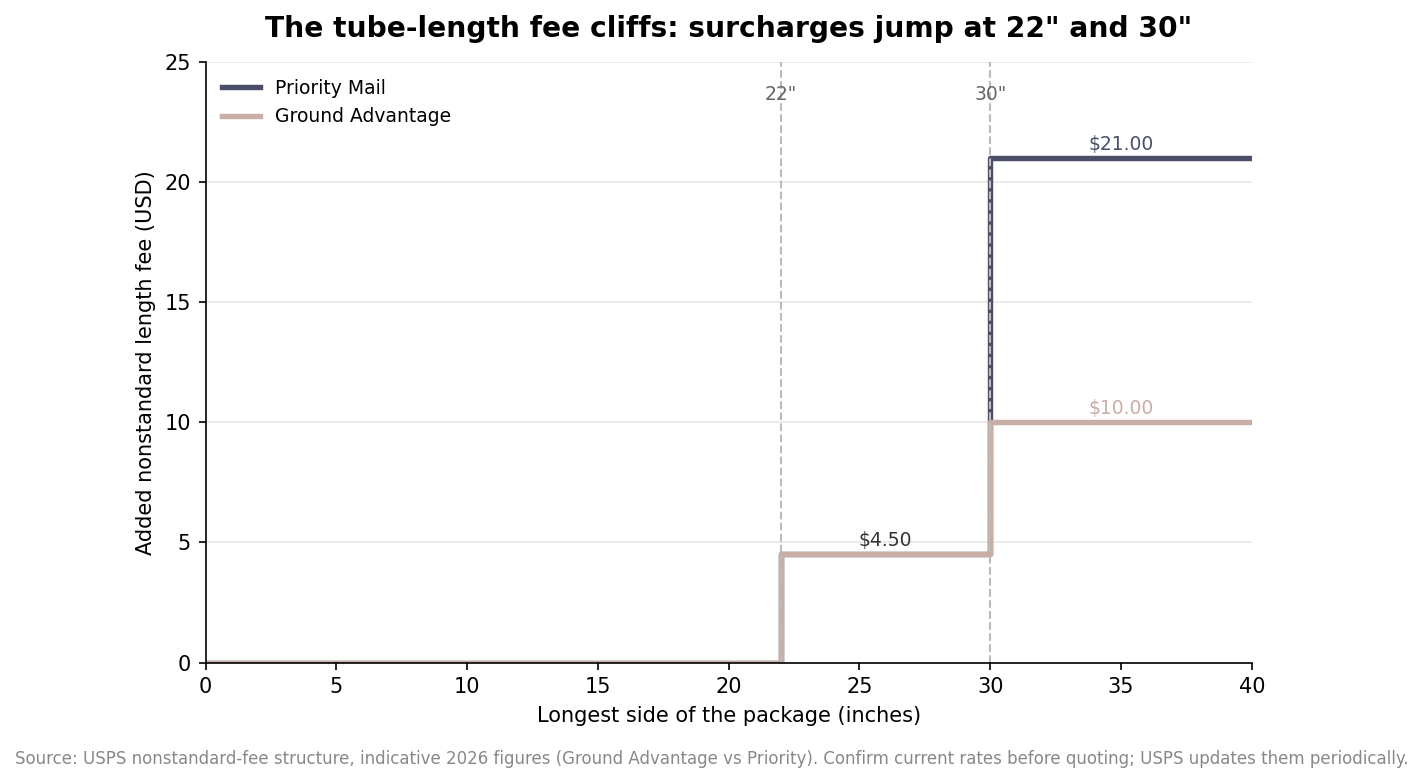
The reason this catches so many sellers is that the poster or print inside sets a floor on the tube length. A rolled 24-by-36-inch poster needs a tube at least a little longer than 24 inches, which already clears the first threshold, and anything shipping a 36-inch or larger print pushes past the second. You are paying the surcharge before you ever print your logo on the tube.
Where common tube lengths actually fall
Stock mailing tubes cluster around a handful of lengths, and it is worth seeing which tier each one lands in. Short tubes of 12 to 18 inches, used for small prints, documents, and rolled apparel, stay under 22 inches and dodge the length fee entirely. The moment you move to a 24-inch tube for a standard poster, you enter the first surcharge band, and the popular 36- and 43-inch tubes for large-format prints and blueprints sit squarely in the highest band.
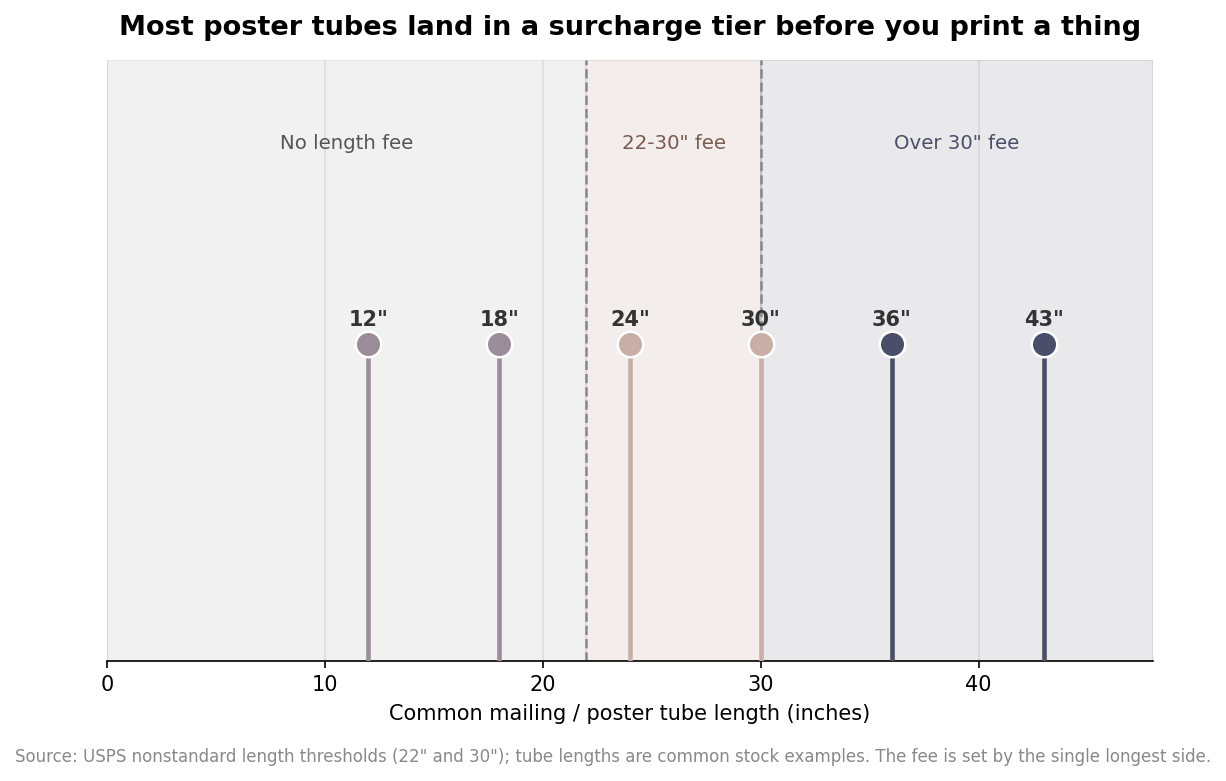
The practical takeaway is to buy the shortest tube that still protects the contents rather than defaulting to an oversized one. Trimming a tube from 25 inches to under 22, when the artwork allows a tighter roll, removes a fee on every single unit. When the print genuinely is large, accept that the surcharge is coming and choose the service where it costs the least.
The other fees and rules to know
Length is the big one, but a few other charges stack on top. Tubes can also draw a nonstandard characteristics fee, roughly $4.50 as of 2026, applied because their shape is awkward for automated handling regardless of size. Parcels exceeding two cubic feet, which is 3,456 cubic inches, pick up an additional volume fee, though a slim tube rarely reaches that. There is also a small fee for shipments sent without dimensions, so declaring accurate measurements in your shipping software is worth the habit. Media Mail is exempt from these nonstandard fees, but most posters, art prints, and marketing materials do not qualify as Media Mail, which is reserved for educational media, so do not assume that exemption applies to a promotional print.
How to keep tube shipping affordable
Start by matching the tube length to the tightest safe roll of the contents, because every inch you can shave below a threshold is money back on each shipment. Compare services deliberately: for a long tube over 30 inches, Ground Advantage often wins once the heavier Priority surcharge is included, unless you specifically need the faster transit. Weigh whether a flat, rigid photo mailer beats a tube for smaller prints that can ship unrolled and stay under 22 inches on the longest side, since a flat piece avoids the round-shape penalties altogether. Finally, treat the dollar figures in this guide as a planning framework rather than a live rate sheet; the thresholds of 22 and 30 inches and the 108-inch combined limit are stable, but the exact surcharge amounts change with each USPS pricing update, so verify them against the current published rates before you commit a season of orders to one tube size.
Leave a Reply