When you order mailing tubes for prints, posters, blueprints, or rolled textiles, the first fork in the road is shape. Almost every catalog offers a familiar round tube and a triangular one, often at a similar price, and the listing rarely explains why you would pick one over the other. The two protect a rolled item about equally well, but they behave very differently once they hit a warehouse shelf, a conveyor belt, and a carrier’s rate table. Here is a spec-by-spec comparison to help you match the tube to how you actually ship.
The shape difference shows up on the loading dock
Round tubes are spiral-wound from kraft paperboard, typically two or three plies thick, with a wall in the rough range of 0.06 to 0.09 inches depending on grade. They arrive rigid and ready, close with plastic end caps that press or twist into place, and stack into cylindrical nests that waste some shelf space. Their defining habit is that they roll. On a sortation conveyor a round tube can drift, turn, and present its label at an angle that a scanner struggles to read.
Triangular tubes are cut and scored from corrugated fiberboard, commonly a 200-pound B-flute board in kraft or oyster white, and they ship to you flat. You fold them into a three-sided prism and close the ends with locking tabs, so no tape or plastic cap is required. The flat panels are the whole point: a triangle sits still on a belt, interlocks with its neighbors in a truck or on a pallet, and stores as flat blanks that take a fraction of the space of pre-formed round tubes. For a fulfillment operation running automated label scanning, a package that will not roll is a measurable convenience.
Strength, closures, and protecting the contents
On raw protection there is less daylight between the two than vendors imply. A rolled poster inside either style is cushioned by the air gap around it and the stiffness of the wall, and most suppliers describe their round and triangular lines as comparable in bending and crush resistance for the same board weight. The triangle earns its strength from geometry: three flat panels meeting at reinforced edges resist flexing without needing a heavier wall, which is why a triangular tube can weigh less than a round tube of similar capacity while surviving the same handling.
The closures diverge in a way worth thinking about. Round tubes with reusable twist-off or pull caps are the better choice when the recipient will open and reclose the tube repeatedly, such as a rolled document that lives in the tube between uses. Triangular tubes with locking tabs are built to be sealed once and opened once; they excel as a one-way shipper but are not meant for repeated reuse. If your product is a keepsake print that a customer stores rolled, the reusable round cap has real end-user value. If it is a poster headed out the door to be unrolled and framed, the tape-free locking triangle saves a packing step.
What each style costs to buy, and to ship
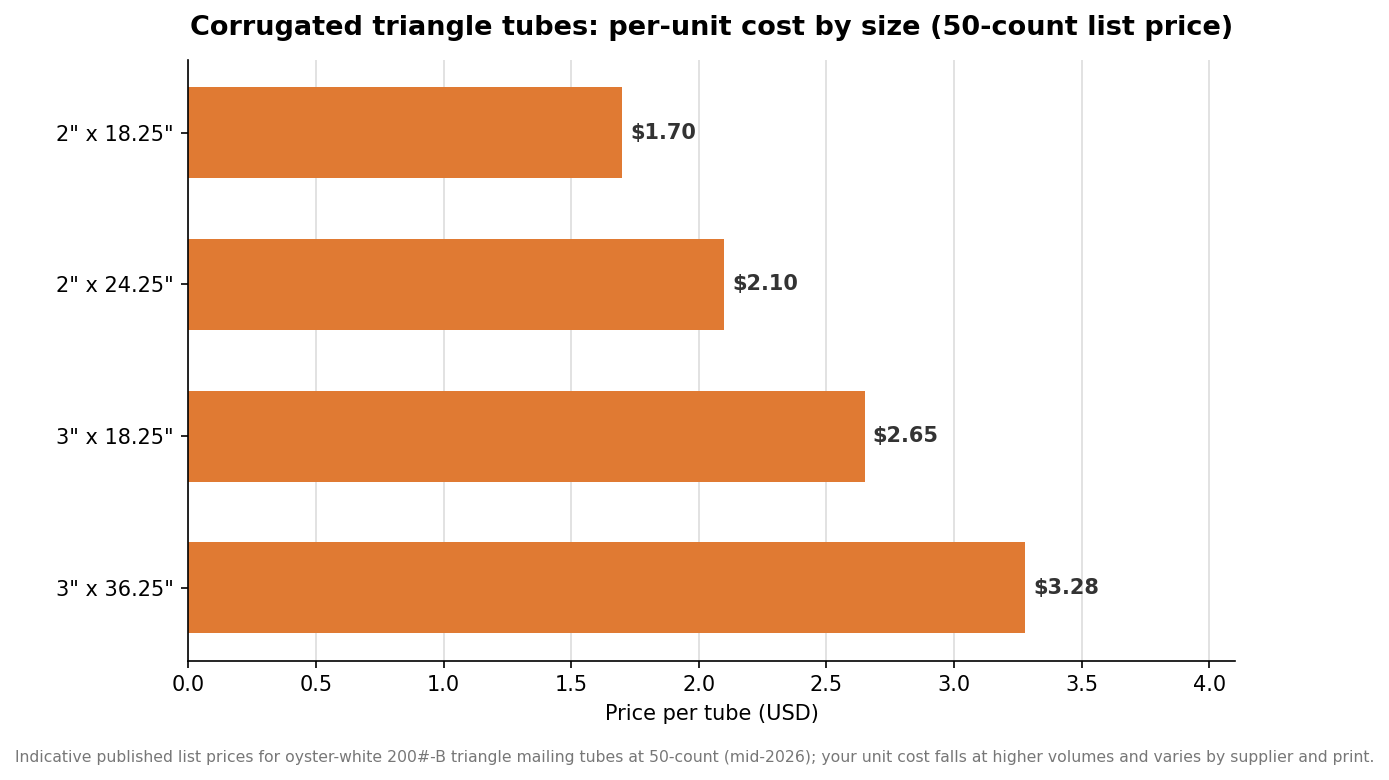
Purchase price tracks size and board more than shape. Corrugated triangle tubes in common sizes land in the low single digits per unit at modest quantities, as the published list prices below show, and per-unit cost drops as you move into thousands. Round kraft tubes occupy a similar band, with the plastic end caps adding a few cents per pair. Neither shape has a decisive purchase-cost advantage; the real money is on the shipping side.
Dimensional weight is where tube choice quietly moves your postage. Carriers bill the greater of a parcel’s actual weight and its dimensional weight, which is the volume of the bounding box divided by a divisor: USPS uses 166 and applies dimensional pricing once a parcel exceeds one cubic foot, or 1,728 cubic inches, while UPS uses a tighter 139. Because a tube is priced on the rectangular box that contains it, the diameter matters far more than most shippers expect. A rolled poster is light, often well under two pounds packed, so once a tube is large enough its dimensional weight, not the poster, sets the rate.
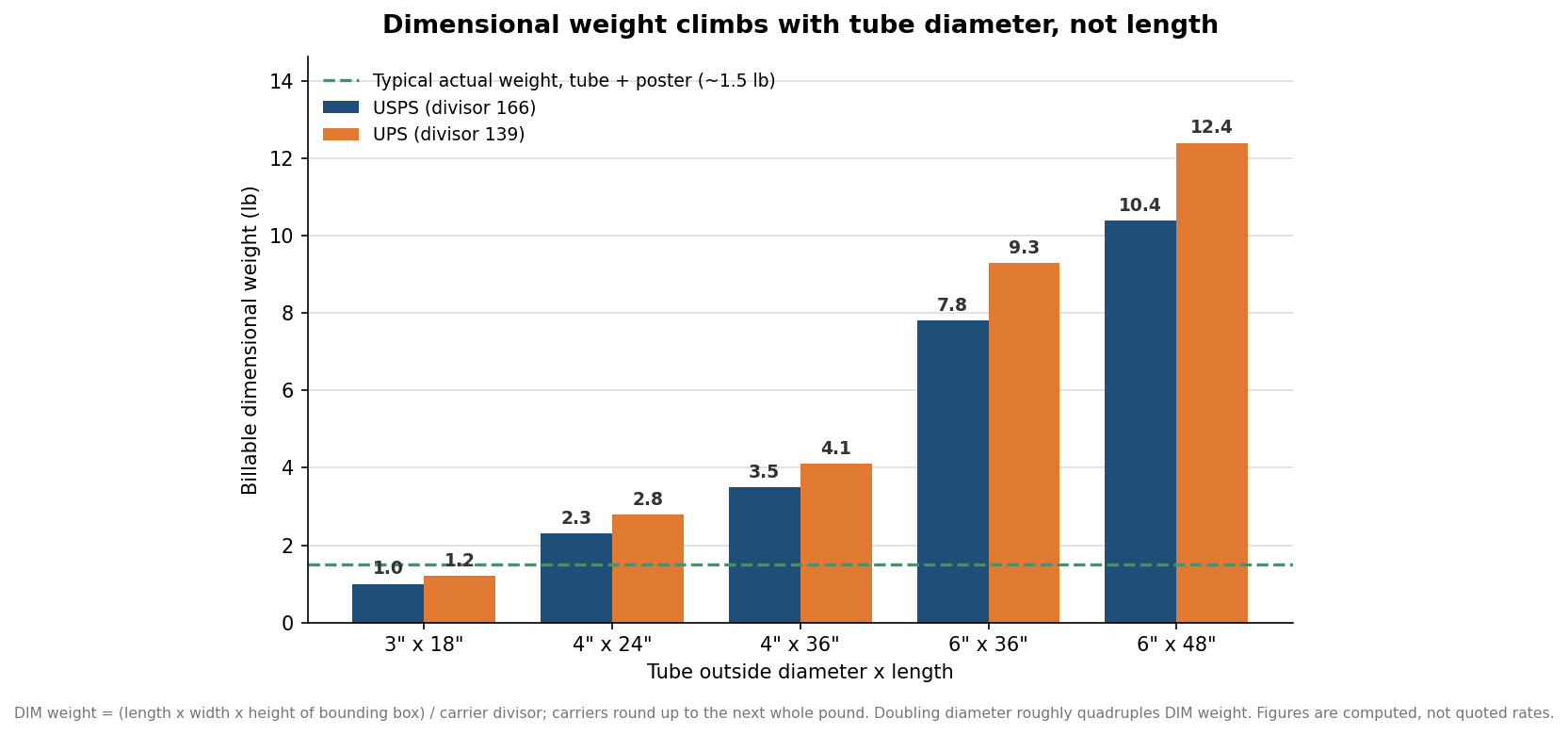
The pattern in that chart is the single most useful spec insight for tubes: doubling the diameter roughly quadruples dimensional weight, because the bounding box grows with the square of the width. A six-inch tube can bill at ten pounds or more on a poster that actually weighs one, while a three-inch tube for the same length stays near a single pound. The practical rule is to choose the smallest inside diameter that lets the contents roll without creasing, and to resist the temptation to size up for margin. Length drives dimensional weight far less, though it triggers a separate set of concerns: USPS treats greater lengths as nonstandard and adds handling fees at length thresholds that have sat around 22 and 30 inches in recent rate tables, and beginning with the July 12, 2026 phase of its dimension rules, parcels over one cubic foot or longer than 22 inches face a roughly three-dollar noncompliance fee when dimensions are missing or wrong. Enter accurate dimensions on every label regardless of which tube you pick.
Print surface and brand presentation
If the tube is part of the unboxing, the triangle has the better canvas. Its flat faces take crisp flexographic or litho-label printing edge to edge, with no curvature to distort a logo or type, and three distinct panels give you room for a brand mark, a message, and handling instructions without crowding. A round tube prints well too, but the curved surface limits how a design reads from a single viewpoint and makes precise registration harder. For a plain shipper where nobody but the sorter sees the outside, this is moot and the round tube’s simplicity wins. For a retail-facing or gift presentation, the triangle’s flat panels are a genuine advantage.
How to choose
Match the tube to the dominant constraint. If your items are reused and stored rolled, or you value the simplest possible pre-formed shipper, the round tube with a reusable cap is the straightforward pick. If you ship through automated fulfillment, want tubes that store flat and will not roll off a belt, care about branded flat panels, or are trimming every ounce of dimensional weight, the triangular tube rewards the switch. Across both shapes, the decision that saves the most money is diameter discipline: size the tube to the contents, keep the width down, and let the chart above remind you why a slightly snugger tube ships for so much less.
Whichever shape you land on, order a small sample run, roll your actual product into it, and weigh and measure the packed tube before you commit to thousands. The bounding-box math and the closure feel are much easier to judge with a real tube in hand than from a catalog line, and a ten-minute test protects both your contents and your shipping budget.
Leave a Reply