Anyone shipping prints, posters, or artwork eventually faces the same fork in the road: roll it into a mailing tube, or lay it flat inside a rigid stayflat mailer. Both are built to get a paper product to a customer uncreased, and both fail in different ways when they are specified badly. The right choice comes down to what you are shipping, how big it is, whether it can be rolled at all, and what the package has to survive on the truck. This is a spec-level comparison to help you pick the format and then dial in the dimensions.
The short version: tubes win on structural strength and on shipping anything large, because a cylinder resists crushing and bending far better than a flat panel and a long print simply cannot travel flat without an enormous, expensive mailer. Flat rigid mailers win on convenience and on items that must not be rolled at all, up to a moderate size. Everything after this is about the numbers behind that trade-off.
How each format protects the contents
A tube protects by geometry. Rolled into a cylinder, cardboard gains hoop strength: the curved wall resists a crushing load and, critically, resists the bending and creasing that ruins a flat print in transit. That is why tubes are the default for valuable art, blueprints, and technical drawings — the shape itself is the protection, and it holds up under stacking in a trailer. The weak points of a tube are the ends, which is why end plugs and the way you cap the tube matter as much as the wall.
A flat rigid mailer protects by stiffness. Heavy fiberboard panels keep a photo or unrolled print flat and resist casual bending, and the peel-and-seal closure makes them fast to pack. But a flat panel is more vulnerable to corner damage and to bending under heavy loads, especially as it gets larger, and the thin construction limits how much abuse it can take before a crease reaches the contents. For small, flat items that should never be rolled — photographic prints, certificates, single sheets — that is an acceptable trade. For anything large or high-value, the tube’s geometry is hard to beat.
Wall thickness is the spec that actually matters
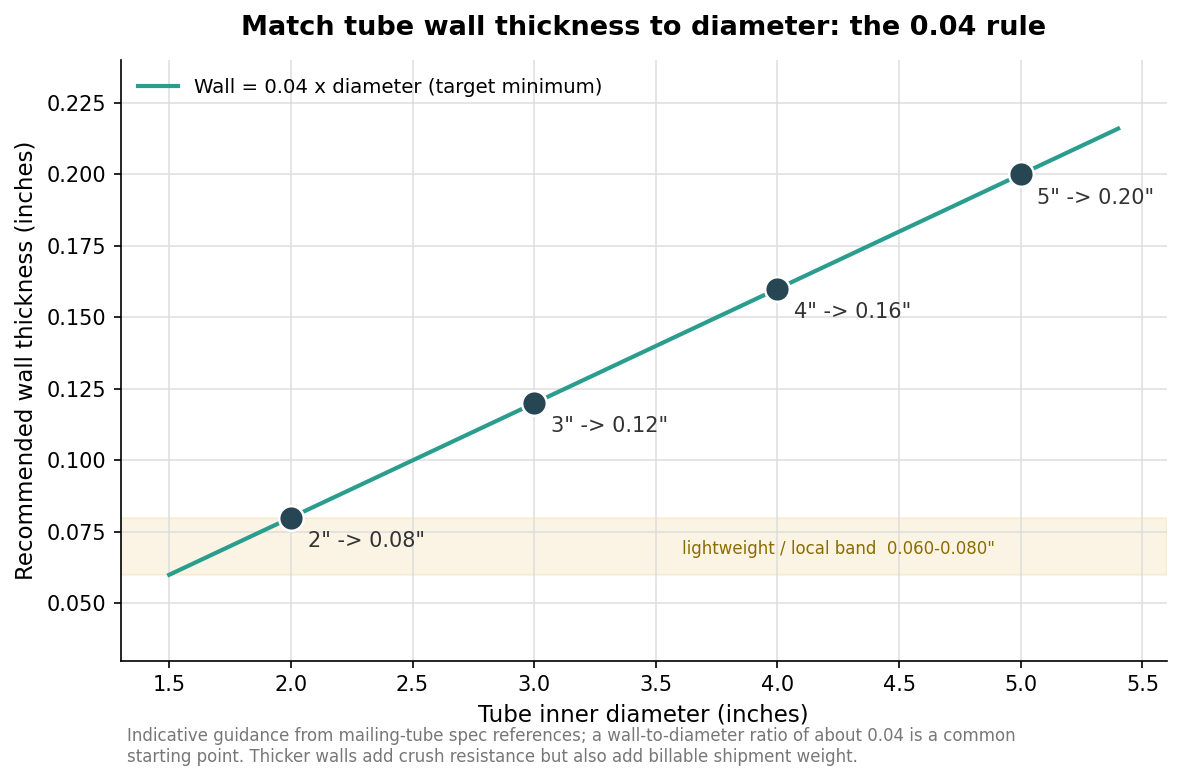
With a tube, diameter gets all the attention but wall thickness determines whether the tube survives. Mailing-tube walls commonly run from about 0.060 to 0.080 inches for lightweight or local shipments, 0.080 to 0.120 inches for standard e-commerce, 0.120 to 0.180 inches for high-value or international parcels, and 0.180 inches and up for industrial use. In ply terms that is roughly two to three plies for thin, flexible walls and four to eight or more plies for rigid ones.
A useful starting rule is to keep the wall thickness at least about four percent of the tube’s diameter — a wall-to-diameter ratio near 0.04. By that guide a three-inch tube wants a wall around 0.120 inches, and a four-inch tube around 0.160 inches, because a wider tube has a longer unsupported span across its diameter and needs a thicker wall to hold its shape under load. The catch is weight: every extra ply adds to the billable scale weight of the shipment, so over-speccing the wall quietly raises your per-parcel cost. Match the wall to the value and the journey, not to a worst case you will never see.
Sizing the tube to the contents
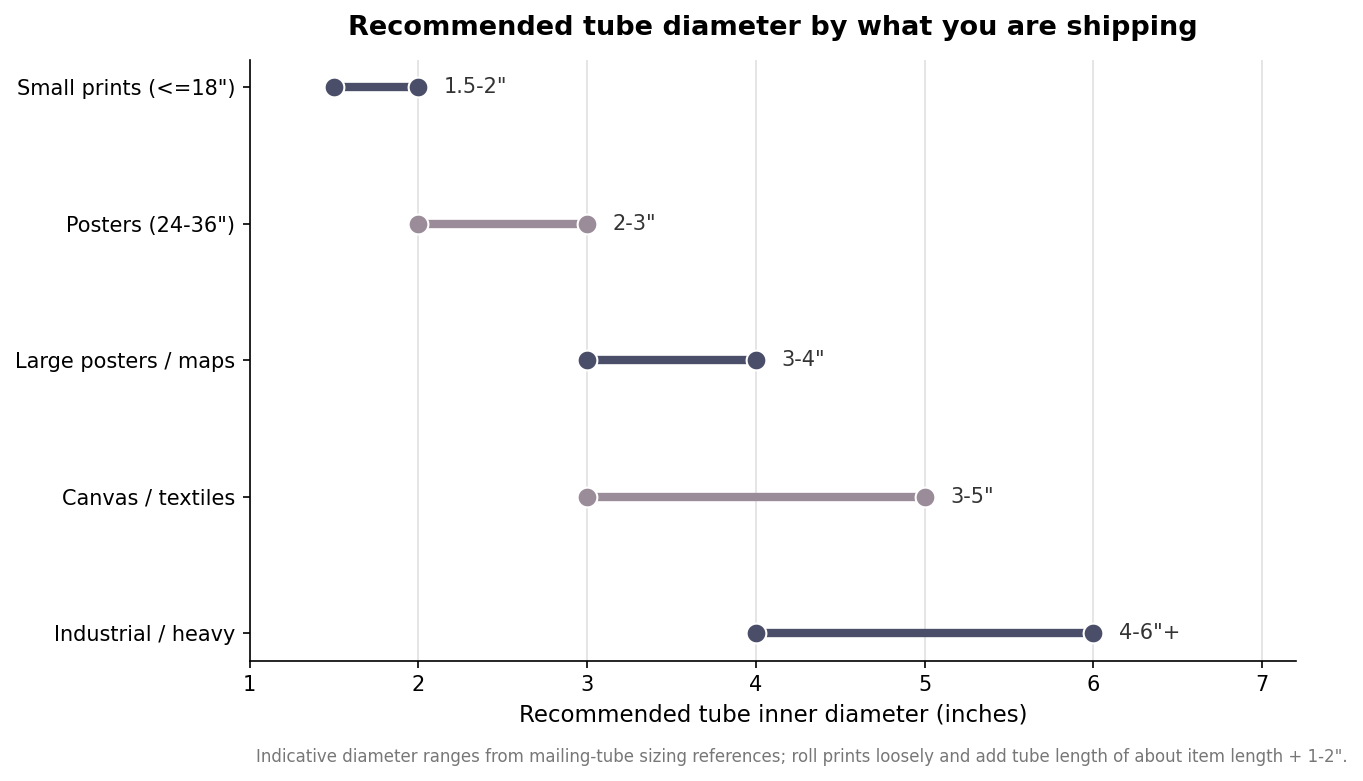
Diameter should follow what you are rolling. Small prints up to about 18 inches roll comfortably into a 1.5 to 2 inch tube; standard posters in the 24 to 36 inch range want 2 to 3 inches; large posters and maps move up to 3 to 4 inches; canvas and textiles, which cannot be rolled tightly without damage, need 3 to 5 inches; and heavy industrial rolls start at 4 inches and climb. Rolling loosely into a larger diameter is gentler on the print than cramming it into the smallest tube that will technically hold it, and it reduces the memory curl the customer has to fight when they unroll it.
Length is simpler: aim for the item length plus about one to two inches so the print sits inside the caps without being jammed, tightening to plus half an inch to one inch only when you want the snuggest possible fit, and allowing plus three inches for heavy industrial applications. Too much extra length lets the roll shift and telescope; too little forces the print against the end caps.
Cost, dimensional weight, and carrier limits
Cost comparisons between tubes and flat mailers are rarely about the packaging price alone; they are about how the carrier charges for the shape. Long tubes can trip length-based surcharges and non-standard package fees with the major carriers, and a large flat mailer can be billed on dimensional weight even when the contents weigh almost nothing. Before you standardize on a format, price a real parcel in both configurations with your actual carrier, because a package that looks cheaper to buy can be more expensive to ship every single day.
As a practical matter, flat rigid mailers make sense from roughly 6 by 8 inches up to the low-to-mid twenties on a side — think 17 by 21 or 22 by 27 — where the panel is still stiff enough to matter and the parcel stays within normal mailer handling. Past that, the flat option gets unwieldy and vulnerable, and a tube becomes both stronger and easier to ship. If a print must never be rolled and it is larger than a mailer can safely carry, the honest answer is a rigid flat box with corner protection rather than an oversized stayflat.
Choosing between them
Start with one question: can the item be rolled? If it cannot — a mounted photo, a rigid certificate, a print the customer expects to arrive dead flat and small — use a flat rigid mailer and keep it within a size the panel can actually protect. If it can be rolled, and especially if it is 24 inches or longer or genuinely valuable, use a tube and spec the wall to the diameter using the 0.04 guideline. Choose the diameter from the contents, add an inch or two of length, and cap the ends properly. Get those few numbers right and either format will deliver an uncreased print; get them wrong and you will pay for it in damage claims, reprints, or shipping surcharges that never show up until the invoice.
Leave a Reply